
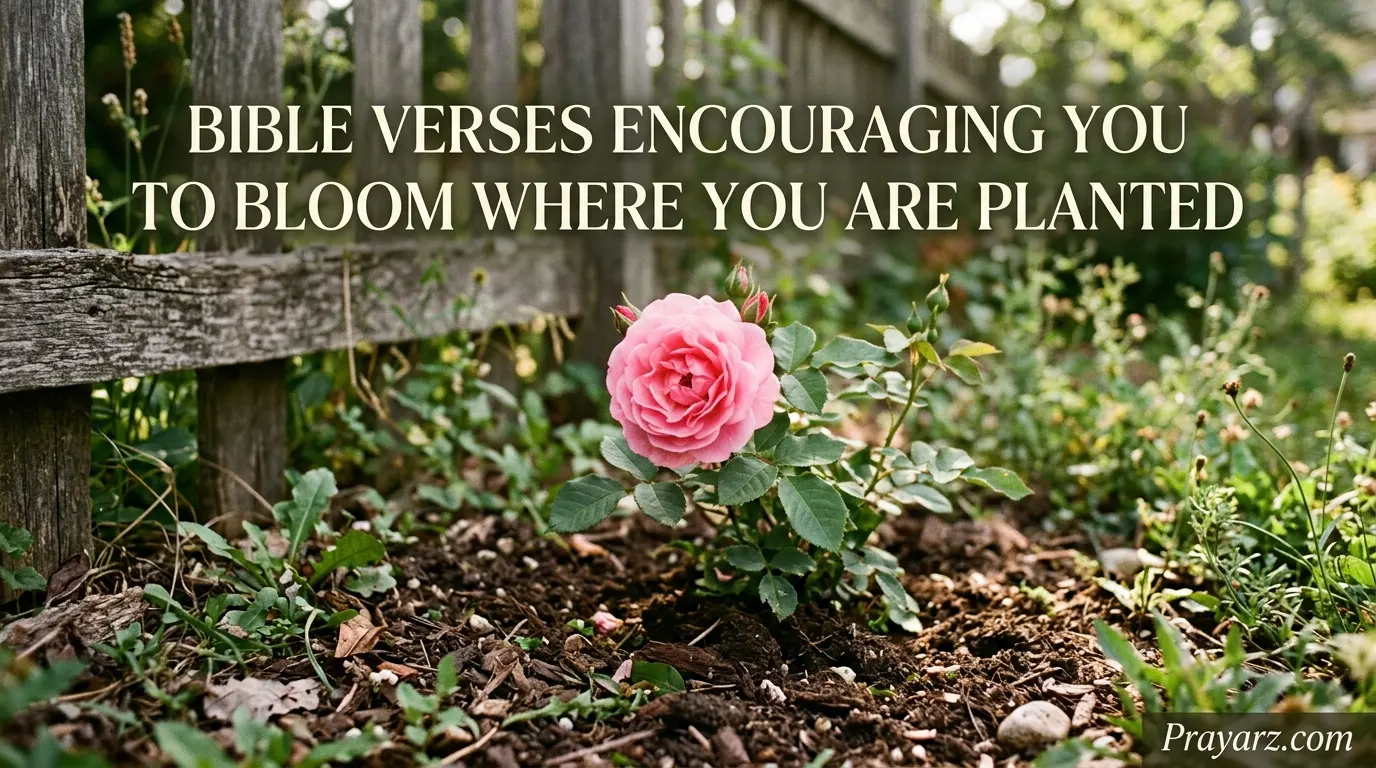
You may not have chosen your present circumstances. Perhaps you are living in a place that does not feel like home, working in a position that seems unfulfilling, waiting for a relationship to change, or walking through a season you never expected. During such times, it is easy to believe that meaningful growth can begin only after everything improves. These Bible verses encouraging you to bloom where you are planted remind us that God can bring growth, purpose, and fruitfulness in every season of life.
Scripture offers a different perspective. God can produce spiritual growth, lasting fruit, and meaningful purpose in the place where you are standing today. Your surroundings do not limit His power. A difficult season may be uncomfortable, but it does not have to be unproductive.
The familiar phrase “bloom where you are planted” does not appear as a direct quotation in the Bible. However, its central idea can be seen throughout Scripture. God repeatedly calls His people to remain faithful, develop strong spiritual roots, serve others, and bear fruit wherever His providence has placed them.
Blooming does not mean pretending that every circumstance is good. It means trusting that God can work through the present situation while you continue seeking His direction. It also means refusing to postpone obedience, kindness, service, or spiritual growth until life becomes easier.
The following passages reveal how believers can become rooted in God, embrace their current assignments, persevere through hardship, and flourish through His grace.
What Does It Mean to Bloom Where You Are Planted?
To bloom where you are planted means to live faithfully, grow spiritually, and use your God-given abilities in your present circumstances. Rather than waiting for perfect conditions, you begin serving God with what you have and where you are.
This principle involves trust. You may not understand why God has allowed a particular season, but you can believe that He remains present within it. You can also ask Him to reveal what He wants to teach you, develop in you, and accomplish through you.
Blooming Is About Faithfulness, Not Perfection
A flower does not bloom because every day is ideal. It grows through changing temperatures, unexpected storms, and periods of waiting. In a similar way, spiritual maturity often develops through conditions that are far from perfect.
God does not ask you to control every outcome. He asks you to be faithful with the opportunities, responsibilities, relationships, and abilities currently entrusted to you.
Faithfulness may look ordinary. It can include:
- Treating coworkers with respect
- Caring patiently for family members
- Completing small responsibilities with integrity
- Encouraging someone who feels discouraged
- Praying consistently during uncertainty
- Choosing gratitude over constant complaint
- Serving without needing recognition
- Developing the gifts God has given you
These actions may seem small, yet God often produces significant fruit through quiet obedience.
Blooming Is Not the Same as Remaining Passive
Trusting God in your present season does not mean you must remain forever in an unsafe, unhealthy, or harmful environment. Scripture includes many examples of God leading people into new places, relationships, ministries, and responsibilities.
Abraham was called to leave his homeland. Moses led Israel out of slavery. Ruth moved to Bethlehem. Paul traveled widely to share the gospel. Even Jesus withdrew from certain places when His mission required it.
Therefore, flourishing where you are does not forbid change. Instead, it teaches you not to waste the present while seeking God’s wisdom about the future. You can prepare for a new opportunity while remaining faithful to today’s responsibilities.
Psalm 1:1–3 — Become Rooted in God’s Word
Psalm 1 describes the righteous person as a tree planted beside streams of water. This tree produces fruit in its season, and its leaves do not wither.
The image offers an important lesson: spiritual flourishing begins beneath the surface. A healthy tree bears visible fruit because its hidden roots are receiving nourishment. In the same way, a believer’s outward life is strengthened through an inward relationship with God.
Deep Roots Come Before Visible Fruit
People often desire quick results. We want immediate answers, noticeable progress, and clear evidence that our efforts are succeeding. However, God frequently develops roots before He reveals fruit.
Roots represent the unseen practices that strengthen faith:
- Reading and meditating on Scripture
- Spending time in prayer
- Listening for God’s direction
- Practising obedience
- Confessing sin
- Receiving wise counsel
- Worshipping during difficult seasons
- Remembering God’s past faithfulness
These habits may not produce instant public recognition. Nevertheless, they prepare you to remain steady when circumstances become difficult.
Fruit Appears in the Right Season
Psalm 1 says that the tree produces fruit “in its season.” This wording reminds us that growth follows God’s timing rather than our preferred schedule.
A healthy tree is not fruitless simply because its branches appear empty during winter. The roots may still be alive, active, and preparing for a future season.
You may currently feel that little is happening. Your prayers may seem unanswered, your work may appear unnoticed, or your progress may feel slow. Psalm 1 encourages you to continue drawing strength from God. Fruitfulness is not always immediate, but faithfulness is never wasted.
Jeremiah 17:7–8 — Trust God in Seasons of Heat
Jeremiah compares the person who trusts in the Lord to a tree planted near water. Its roots stretch toward the stream, and it does not become fearful when heat arrives. Even during drought, it remains green and continues producing fruit.
This passage does not promise a life without heat or drought. Instead, it describes a life that remains spiritually alive despite them.
Faith Does Not Depend on Easy Conditions
Some people appear strong when life is comfortable but lose hope when difficulties arise. Biblical faith develops a deeper source of strength.
The tree in Jeremiah 17 survives because its roots reach water that is not controlled by the weather. Likewise, believers receive life from God rather than depending entirely on external conditions.
The peace does not have to depend on everyone treating you fairly. Your purpose does not have to disappear when plans change. Your joy does not have to be destroyed by one disappointing season.
Trust allows your soul to draw from a source deeper than present circumstances.
Extend Your Roots Toward God
During hardship, you may instinctively withdraw, worry, or attempt to control everything. Jeremiah offers a better response: extend your roots toward the Lord.
You can do this by:
- Bringing your fears honestly to God
- Reading passages that remind you of His character
- Seeking support from mature believers
- Replacing anxious thoughts with biblical truth
- Remembering previous answers to prayer
- Continuing to serve even when emotions fluctuate
- Thanking God for daily evidence of His care
Heat may reveal where your trust is placed. It can also help your roots grow deeper.
Jeremiah 29:4–7 — Seek the Good of Your Present Place
Jeremiah 29 was written to Jewish exiles living in Babylon. They had been removed from their homeland and were living in a place they did not choose. Many longed to return home quickly.
God instructed them to build houses, plant gardens, establish families, and seek the peace and prosperity of the city where they had been carried.
This was not the message they probably wanted. Yet it showed that exile did not remove their ability to live meaningful and faithful lives.
Do Not Put Your Life Completely on Hold
When circumstances feel temporary, it is tempting to stop investing in them. You may think, “I will serve when I find a better church,” “I will become joyful after I get a new job,” or “I will build relationships after I move.”
Jeremiah 29 challenges this mindset. The exiles were told to participate responsibly in the life around them, even while hoping for eventual restoration.
You can still plant seeds of goodness during a temporary season. You can build healthy relationships, develop new skills, support your community, and honour God through daily responsibilities.
Seek the Welfare of Others
Blooming is not merely about personal success. God instructed the exiles to seek the welfare of the city and pray for it.
Your current location contains people who may need your kindness, experience, encouragement, prayers, or practical help. Instead of asking only, “How can I escape this situation?” consider asking, “How can God use me here?”
You might:
- Support a struggling coworker
- Volunteer in your local community
- Pray regularly for your neighbourhood
- Encourage another parent
- Mentor a younger believer
- Help someone carry a practical burden
- Bring integrity into a difficult workplace
- Create peace within a tense relationship
Your current place may become better because you chose to serve faithfully within it.
John 15:4–5 — Abide in Christ to Bear Fruit
Jesus used the image of a vine and branches to explain spiritual fruitfulness. A branch cannot bear fruit by itself. It must remain connected to the vine.
The lesson is clear: lasting fruit does not come from constant striving alone. It comes from remaining connected to Christ.
Your Location Is Less Important Than Your Connection
A branch can remain fruitful only when it receives life from the vine. Likewise, your spiritual condition depends more on your connection with Jesus than on your geographical location, job title, relationship status, or social influence.
You may believe you would flourish if you lived somewhere else or had a different opportunity. External change can sometimes be helpful, but it cannot replace communion with Christ.
A person can feel empty in an impressive position. Another can live with deep purpose in an overlooked role. The difference is often the source from which each person is drawing life.
Practise Daily Abiding
Abiding in Christ is not a single emotional experience. It is a continuing relationship marked by dependence, trust, obedience, and love.
Daily abiding can include:
- Beginning the day with prayer
- Reading Scripture slowly and thoughtfully
- Asking Jesus for wisdom before making decisions
- Obeying biblical convictions
- Turning to God during emotional pressure
- Confessing your need for His strength
- Remaining aware of His presence
- Choosing love when selfishness feels easier
The closer you remain to Christ, the more His character becomes visible in your life.
Galatians 5:22–23 — Cultivate the Fruit of the Spirit
Galatians identifies the fruit produced by the Holy Spirit: love, joy, peace, patience, kindness, goodness, faithfulness, gentleness, and self-control.
These qualities provide a biblical picture of what genuine blooming looks like. Spiritual flourishing is not measured only by achievements, income, popularity, or public recognition. It is revealed through Christlike character.
Difficult Places Can Develop Beautiful Character
Patience is rarely developed when everything happens immediately. Peace becomes meaningful when circumstances are uncertain. Self-control grows when temptation is present. Faithfulness is proved through long seasons of ordinary obedience.
The place that frustrates you may also be the place where the Holy Spirit is shaping you.
A challenging coworker can teach patience. A period of waiting can strengthen trust. An unnoticed responsibility can develop humility. A disappointing change can deepen dependence on God.
This does not mean that every hardship is good. It means God can produce good fruit even within hardship.
Ask the Holy Spirit to Work Within You
Personal effort has value, but spiritual fruit ultimately comes through the Holy Spirit. You cannot manufacture Christlike character through willpower alone.
Invite the Holy Spirit into your present situation. Rather than praying only for the circumstances to change, also pray for your heart to be transformed.
You might pray:
“Holy Spirit, teach me to respond with love. Give me patience while I wait. Grow peace within me when I feel anxious. Help me remain faithful when no one notices. Produce the character of Christ in this season.”
Such a prayer does not ignore the difficulty. It asks God to keep the difficulty from being wasted.
Colossians 3:23–24 — Work Wholeheartedly for the Lord
Paul encouraged believers to approach their work wholeheartedly, as service offered to the Lord rather than merely to human authorities.
This principle gives meaning to tasks that may otherwise feel repetitive, unimportant, or unnoticed.
Ordinary Work Can Become Worship
Not every assignment will feel exciting. Some responsibilities involve cleaning, organising, answering messages, caring for children, studying, preparing meals, managing paperwork, or supporting others behind the scenes.
When these tasks are completed with honesty and excellence, they can become acts of worship.
Your purpose is not limited to activities performed inside a church building. God can be honoured in offices, classrooms, kitchens, hospitals, workshops, homes, shops, and fields.
The task may appear ordinary, but the One you serve gives it eternal significance.
Do Not Depend Entirely on Human Recognition
Working only for approval creates disappointment. People may overlook your effort, misunderstand your motives, or fail to express gratitude.
Colossians 3 redirects your attention toward God. He sees the work that others miss. He knows when you choose honesty, patience, generosity, and excellence.
This does not mean unfair treatment should be ignored. Healthy communication and appropriate boundaries still matter. However, your deepest motivation can remain secure because it comes from serving Christ.
1 Corinthians 7:17 — Live Faithfully in Your Present Calling
Paul instructed believers to live faithfully according to the situation and calling God had assigned to them. The wider passage addresses different social and personal circumstances within the early church.
The central principle is not that every condition must remain unchanged. Instead, believers should not assume they need a completely different life before they can obey God.
Your Calling Begins Today
Many people imagine purpose as a future destination. They believe their calling will begin after graduation, marriage, promotion, relocation, healing, financial stability, or public recognition.
Scripture teaches that calling also includes your present obedience.
Your current calling may involve:
- Loving your family well
- Completing your education faithfully
- Working with integrity
- Caring for someone who depends on you
- Growing in wisdom
- Serving within your local church
- Developing a skill
- Healing from a painful experience
- Learning to manage resources responsibly
Future assignments may come, but today still matters.
Avoid Comparing Your Assignment With Someone Else’s
Comparison can make your own life appear small. Social media and public success stories often display visible outcomes without showing hidden years of preparation.
God does not measure your faithfulness by comparing your assignment with another person’s. He asks you to steward what He has entrusted to you.
One person may serve before thousands. Another may encourage one discouraged child. Both acts can hold great value when performed in obedience to God.
Philippians 4:11–13 — Learn Contentment in Every Situation
Paul wrote about learning to be content whether he had plenty or little. His contentment did not come naturally or instantly. It was something he learned through experience and dependence on Christ.
Contentment is an essential part of flourishing because constant dissatisfaction prevents us from seeing present blessings and opportunities.
Contentment Is Learned
Paul’s words show that contentment develops over time. It grows as you experience God’s provision in changing circumstances.
Over time, you begin to understand that possessions alone cannot bring lasting peace. Success may open new doors, but it does not eliminate every challenge. Through both seasons of abundance and times of need, God’s faithfulness remains unchanged.
Contentment does not mean you have no goals. It means your inner stability is not controlled by whether every goal has already been achieved.
Contentment and Ambition Can Coexist
Biblical contentment is not laziness. Appreciating your present life does not mean giving up on future growth. You can value your current home while saving for a different one, serve faithfully in a small ministry while preparing for greater responsibility, and remain grateful for your current job even as you apply for a new opportunity. Responsible planning and contentment can work together.
Healthy ambition says, “I will pursue growth while trusting God.” Discontent says, “I cannot have peace until everything changes.”
Christ gives strength for both faithful waiting and courageous action.
Galatians 6:9 — Do Not Grow Weary in Doing Good
Galatians encourages believers not to become weary in doing good because a harvest will come at the proper time if they do not give up.
This verse speaks directly to people who have been planting seeds without seeing immediate results.
Good Seeds Often Grow Slowly
You may have prayed for years, served faithfully, invested in relationships, raised children with love, worked honestly, or encouraged others without seeing the outcome you hoped for.
Seeds develop underground before anything appears above the soil. In a similar way, God may be working through your efforts long before visible results emerge.
A kind conversation may influence someone months later. A child may remember a lesson years afterward. A faithful example may inspire people who never tell you.
You are responsible for planting and watering. God remains responsible for the growth.
Rest Without Giving Up
Weariness is not always a sign that you lack faith. Even faithful people need rest, support, and renewal.
Jesus invited His disciples to step away and rest after demanding ministry. Elijah needed sleep and nourishment during emotional exhaustion. The biblical response to weariness is not always to work harder.
Sometimes perseverance means resting, receiving help, adjusting expectations, and returning with renewed strength.
Do not confuse rest with surrender. A field may appear inactive during certain seasons, yet important restoration is taking place.
Ecclesiastes 3:1 — Accept the Seasons of Life
Ecclesiastes teaches that there is a season and an appropriate time for every activity under heaven.
Life contains beginnings and endings, celebration and grief, building and letting go. No single season lasts forever.
Every Season Has a Different Purpose
A planting season looks different from a harvesting season. Winter looks different from spring. Each has its own role.
Your current season may be focused on preparation rather than public achievement. It may involve healing, learning, waiting, rebuilding, serving, grieving, or beginning again.
Problems arise when we expect every season to produce the same kind of fruit. A period of recovery should not be judged by the standards of a period of intense productivity.
Ask God what faithfulness looks like now rather than demanding that the present resemble the past.
Do Not Rush What God Is Developing
Rushing can damage growth. Fruit picked too early may not be ready. A foundation built too quickly may not support future weight.
God often uses waiting to develop wisdom, character, patience, and discernment. While waiting can feel unproductive, it may be preparing you for responsibilities you are not yet ready to carry.
Instead of continually asking, “When will this end?” also ask, “What can I learn while I am here?”
Isaiah 43:18–19 — Look for the New Thing God Is Doing
Through Isaiah, God told His people that He was doing something new and making a way in the wilderness and streams in the desert.
This passage offers hope to anyone who feels surrounded by barrenness. God is not limited by the absence of visible resources.
God Can Bring Life to Dry Places
A desert appears incapable of supporting growth. Yet God promises water in the wilderness.
You may look at your present situation and see only limitations. God may see an opportunity for renewal, redirection, and unexpected provision.
A closed door can lead to a healthier path. A disappointing ending can create space for a wiser beginning. An isolated season can deepen prayer. A professional setback can reveal an undeveloped gift.
Not every difficulty automatically produces a positive outcome. However, nothing prevents God from creating a new path when you surrender the situation to Him.
Pay Attention to Small Beginnings
God asked, “Do you not perceive it?” This question suggests that His new work may begin quietly.
New growth can appear as:
- A fresh desire to pray
- An unexpected conversation
- A new opportunity to serve
- A healthy boundary
- A renewed interest in Scripture
- A relationship beginning to heal
- A skill slowly developing
- A burden becoming clearer
- A small step of courage
Do not ignore a beginning simply because it seems small. Many significant works of God start like seeds.
Romans 8:28 — Trust God to Work Through Every Circumstance
Romans 8:28 teaches that God works through all things for the good of those who love Him and are called according to His purpose.
The verse does not say that all things are good. Betrayal, injustice, grief, illness, and disappointment are painful realities. The promise is that God can work within and through them.
God’s Good Purpose May Be Deeper Than Comfort
We often define “good” as an easy life. In Romans 8, the following verse connects God’s purpose with becoming more like Christ.
Therefore, the good God produces may include deeper faith, stronger character, wiser priorities, increased compassion, and greater spiritual maturity.
A season can be painful while still becoming meaningful. You do not need to call the pain good in order to trust God’s ability to redeem it.
Your Story Is Still Being Written
A single chapter cannot reveal the full direction of a story. Moments that appear confusing may later connect with a purpose you cannot currently see.
Joseph’s imprisonment looked like a complete failure. Ruth’s widowhood seemed like an ending. Paul’s confinement appeared to restrict his ministry. Yet God continued working through each situation.
Do not interpret your entire future through one difficult chapter.
The Example of Joseph — Flourishing Through Injustice
Joseph experienced betrayal, slavery, false accusation, and imprisonment. He was repeatedly placed in circumstances he did not choose.
Nevertheless, Genesis shows that the Lord remained with him. Joseph served responsibly in Potiphar’s household and later in prison. His faithfulness prepared him for future leadership in Egypt.
Joseph Served Before He Understood
Joseph did not know how the separate pieces of his life would eventually connect. Joseph’s story is marked by consistent faithfulness. He served diligently in Potiphar’s household, stood firm against temptation, helped those around him in prison, and faithfully exercised his gift of dream interpretation despite seeing no immediate fulfillment of his own dreams..
Your present responsibilities may be preparing you for an assignment you cannot yet see.
God’s Presence Was Joseph’s True Advantage
Joseph did not flourish because his surroundings were favourable. He flourished because God was with him.
The same truth applies today. The presence of God can sustain you in places that do not match your expectations.
Your environment may influence you, but it does not have to define your character. Through God’s grace, you can remain honest in a dishonest workplace, compassionate in a harsh culture, and hopeful in a discouraging season.
The Example of Ruth — Faithfulness in a New Place
Ruth lost her husband and left her homeland to accompany Naomi to Bethlehem. As a Moabite widow, she entered an unfamiliar community with little social security.
Rather than allowing uncertainty to paralyse her, Ruth took responsible action. She gathered leftover grain in the fields to provide food for herself and Naomi.
Ruth Was Faithful With the Opportunity Available
Ruth did not begin with wealth, status, or influence. She began by doing the humble work available to her.
Her story reminds us that purpose often begins with the next responsible step rather than a complete long-term plan.
When the future feels uncertain, ask:
- What responsibility is directly before me?
- Who can I help today?
- Which skill can I use?
- What wise action can I take?
- Where is God already providing an opportunity?
Small acts of faithfulness can open doors you did not know existed.
God Worked Through Ruth’s Ordinary Obedience
Ruth’s daily work led her to the field of Boaz. Their eventual marriage placed her within the family line of King David and, ultimately, Jesus Christ.
Ruth could not have seen this outcome while gathering grain. She simply acted with loyalty, humility, and courage.
You may not understand the long-term impact of today’s obedience. God can weave ordinary actions into purposes much larger than you imagine.
The Example of Daniel — Remaining Faithful in a Foreign Culture
Daniel was taken from Judah to Babylon and trained for service in a foreign empire. He lived within a culture that did not share his beliefs.
Despite the pressure, Daniel served with excellence while maintaining his devotion to God.
Daniel Combined Conviction With Wisdom
Daniel did not respond to every cultural difference with hostility. He communicated respectfully, sought wise solutions, and built trust. At the same time, he refused to compromise clear convictions.
This balance is valuable for believers living or working in environments where their faith is not widely shared.
Maintaining your convictions does not require hostility toward others. You can serve people whose beliefs differ from yours, work with excellence in diverse environments, and remain committed to spiritual boundaries without compromising the truth.
Consistency Created a Powerful Witness
Daniel’s influence developed over years. His disciplined prayer, integrity, wisdom, and courage made his faith visible.
A lasting witness is often built through consistency rather than one dramatic moment.
People notice when you remain calm under pressure, tell the truth when dishonesty would be easier, treat others fairly, and maintain hope during hardship.
Your current environment can become a place where Christ’s character is displayed through your daily life.
How to Flourish in Your Current Season
Biblical growth requires more than inspiration. It involves intentional practices that strengthen your relationship with God and help you respond wisely to daily life.
Begin With Honest Prayer
Tell God how you truly feel about your circumstances. You do not need to hide disappointment, frustration, loneliness, or confusion.
The Psalms demonstrate that honest prayer and genuine faith can exist together. David expressed fear, grief, anger, and questions while continuing to seek God.
Honesty allows your pain to become part of your relationship with God rather than a barrier between you and Him.
Identify What Is Within Your Control
You cannot control every person, outcome, or opportunity. However, you can usually control your response, preparation, attitude, boundaries, and daily choices.
Ask yourself:
- Which responsibility can I complete today?
- What habit would strengthen my faith?
- Is there a conversation I need to have?
- Which negative pattern should I surrender?
- Who can I encourage?
- What skill can I begin developing?
- Where do I need a healthier boundary?
Focusing on faithful action reduces the helplessness created by constant worry.
Practise Gratitude Without Denying Pain
Gratitude does not require pretending that everything is wonderful. It means recognising God’s gifts while acknowledging what remains difficult.
Even during difficult seasons, gratitude remains possible. You may feel disappointed with your job yet remain thankful for the income it provides. While waiting for a major answer, you can still recognize God’s smaller provisions and appreciate the faithful friends who stand by your side.
Consider writing down three specific gifts each day. Over time, this practice can train your attention to recognise grace.
Invest in the People Around You
Your current relationships may form part of your present assignment. Rather than viewing people merely as obstacles or resources, ask how you can reflect Christ’s love toward them.
Listen carefully. Offer practical assistance. Speak encouragement. Apologise when necessary. Keep reasonable promises. Pray for people by name.
A flourishing life does not exist only for itself. Healthy spiritual fruit nourishes others.
Use What God Has Already Given You
Do not wait for perfect resources before serving. Begin with the time, knowledge, experience, relationships, and abilities already available.
Moses had a staff. David had a sling. A widow had a small amount of oil. A boy offered five loaves and two fish. God often begins with what appears insufficient.
Your gift may involve teaching, listening, organising, creating, repairing, writing, encouraging, leading, cooking, mentoring, or giving. Offer it faithfully and allow God to direct the outcome.
Remain Open to God’s Redirection
Faithfulness in your current place should be combined with sensitivity to God’s guidance. He may eventually lead you into a new role, city, relationship, ministry, or season.
Seek direction through:
- Scripture
- Prayer
- Wise counsel
- Godly convictions
- Responsible preparation
- Providential opportunities
- Honest evaluation
- Peace accompanied by wisdom
Avoid making major decisions based only on temporary emotion. At the same time, do not use contentment as an excuse to ignore clear guidance.
Signs That You Are Growing Even When Life Feels Unchanged
Spiritual progress is not always dramatic. Circumstances may look similar while important changes occur within you.
Your Reactions Are Becoming Healthier
The challenges around you may not change immediately, but your response to them can. You may find yourself praying before reacting, communicating with greater calm, recovering from disappointment more quickly, and showing more patience than you did in the past.
These changes are evidence of growth.
Your Dependence on God Is Increasing
You may find yourself turning to prayer sooner, recognising your limitations, and trusting God with outcomes you previously tried to control.
Dependence is not weakness. It is a sign that your roots are extending toward the true source of life.
Your Compassion Is Deepening
Pain can either harden the heart or enlarge its capacity for compassion. As God heals and teaches you, you may become more sensitive to people experiencing similar struggles.
Your difficult season may eventually help you encourage others with sincerity and understanding.
Your Priorities Are Becoming Clearer
Challenges often reveal what truly matters. You may become less concerned with approval and more committed to integrity. You may value meaningful relationships above appearances or spiritual health above constant productivity.
Such clarity is a form of flourishing.
You Are Remaining Faithful Without Immediate Results
Continuing to pray, serve, learn, and obey without instant reward demonstrates spiritual maturity.
Visible success is not the only evidence of progress. Sometimes growth is seen simply in the fact that you have not abandoned your faith.
What Blooming Where You Are Planted Does Not Mean
The phrase can be misunderstood when it is separated from the full counsel of Scripture.
It Does Not Mean Accepting Abuse
God does not require you to remain silently in an abusive or dangerous situation. Seeking safety, professional assistance, legal protection, pastoral care, or support from trusted people is not a failure of faith.
Forgiveness also does not require unrestricted access or the removal of wise boundaries.
It Does Not Mean Ignoring Injustice
Biblical faithfulness includes pursuing justice, defending vulnerable people, speaking truth, and confronting wrongdoing wisely.
Daniel challenged an unjust royal decree through continued faithfulness. Esther risked her position to protect her people. The prophets repeatedly spoke against oppression.
You can seek change while maintaining a Christlike spirit.
It Does Not Mean Abandoning Goals
God may place dreams, gifts, and ambitions within you. Growing in your current season can prepare you to pursue them responsibly.
The key is to avoid making future achievement the condition for present peace.
It Does Not Mean Calling Every Circumstance God’s Ideal
Some situations result from human sin, injustice, poor choices, or living in a broken world. Not everything that happens reflects God’s moral desire.
Nevertheless, His presence can meet you there, His wisdom can guide your response, and His grace can bring redemption.
A Prayer to Flourish Where God Has Placed You
Heavenly Father,
Thank You for being with me in every season of life. You see the circumstances I enjoy and the ones I find difficult. You understand the hopes I carry, the changes I desire, and the questions I cannot yet answer.
Help me trust that my present season is not beyond Your reach. Strengthen my roots in Your Word and teach me to remain close to Jesus. When I feel discouraged, remind me that growth is often happening before it becomes visible.
Show me how to serve You where I am. Open my eyes to the people I can encourage, the responsibilities I can complete, and the opportunities I might otherwise overlook.
Protect me from comparison, bitterness, and constant dissatisfaction. Give me contentment without making me passive. Grant me courage to change what should be changed, patience to wait when I should wait, and wisdom to recognize the difference.
Holy Spirit, grow love, joy, peace, patience, kindness, goodness, faithfulness, gentleness, and self-control within me. Let my character reflect Jesus even when my surroundings are difficult.
Redeem the painful parts of my story. Use this season to prepare me, deepen me, and make me more compassionate. Help me believe that no act of obedience is wasted.
May my life bear fruit that blesses others and brings glory to You. Lead me when it is time to stay, and guide me when it is time to move.
In Jesus’ name, amen.
Frequently Asked Questions
Is “bloom where you are planted” an actual Bible verse?
No. The exact phrase does not appear in Scripture. However, its general principle is supported by passages about remaining faithful, bearing fruit, serving God, and growing spiritually in present circumstances.
Psalm 1:1–3, Jeremiah 17:7–8, Jeremiah 29:4–7, John 15:4–5, Colossians 3:23–24, and Galatians 6:9 are especially relevant.
What does blooming where God has placed you mean?
It means developing Christlike character, using your gifts, serving others, and remaining obedient within your current circumstances.
It does not require you to consider every situation permanent. You can prepare for future change while living purposefully today.
Which Bible verse best represents blooming where you are planted?
Psalm 1:3 provides one of the clearest biblical images. It describes a righteous person as a tree planted beside streams of water that produces fruit in season.
Jeremiah 17:7–8 offers a similar picture of a rooted tree that remains green and fruitful even during drought.
How can I grow spiritually when I feel stuck?
Begin with small, consistent actions. Spend time in Scripture, pray honestly, remain connected to a healthy Christian community, serve someone nearby, and practise gratitude.
You can also identify one area of character God may be developing, such as patience, courage, humility, or self-control.
Does being content mean I should stop pursuing change?
No. Biblical contentment means finding stability in Christ rather than depending completely on circumstances. It does not prevent responsible ambition, planning, education, relocation, or career development.
You can pursue change without allowing dissatisfaction to control your heart.
How do I know whether God wants me to stay or move?
Seek guidance through Scripture, prayer, wise counsel, careful evaluation, and responsible preparation. Consider whether your desire to move comes from clear direction or merely temporary frustration.
Safety also matters. Remaining faithful does not require staying in an abusive or dangerous environment.
What should I do when I cannot see any fruit from my efforts?
Remember Galatians 6:9, which encourages believers not to grow weary in doing good. Some results take time, and some may never become fully visible to you.
Continue planting good seeds, but also allow yourself appropriate rest. Ask God whether your methods need adjustment while trusting Him with the outcome.
Which biblical characters flourished in difficult places?
Joseph served faithfully as a slave and prisoner in Egypt. Ruth demonstrated loyalty and diligence in a foreign community. Daniel maintained courage and integrity in Babylon. Esther used her position in Persia to protect others. Paul continued sharing the gospel while imprisoned.
Their stories show that God’s purpose is not restricted to comfortable surroundings.
Can God use a season I consider wasted?
Yes. God can use waiting, disappointment, grief, failure, or redirection to deepen faith and prepare you for future service.
Romans 8:28 teaches that God works through all circumstances for the good of those who love Him. This does not make painful events good, but it reveals His power to redeem them.
How can I encourage someone who feels trapped in their circumstances?
Listen before offering advice. Acknowledge the difficulty rather than immediately trying to explain it. Remind the person of God’s presence and offer practical support.
Avoid using “bloom where you are planted” to pressure someone into tolerating harm. Encourage faithfulness while also supporting wise boundaries, safety, and appropriate change.
Conclusion
You do not need perfect surroundings to live a fruitful life. Scripture shows trees growing near streams, faithful people serving in foreign lands, and believers producing spiritual fruit during hardship. Their strength did not come from ideal circumstances. It came from the presence and faithfulness of God.
Your present season may not look like the future you imagined. It may involve waiting, rebuilding, serving quietly, learning, healing, or beginning again. Yet this chapter still holds opportunities for meaningful obedience.
Strengthen your roots in Scripture. Remain connected to Christ. Allow the Holy Spirit to shape your character. Complete today’s responsibilities with integrity, notice the people God has placed around you, and trust Him with results you cannot control.
At the same time, remain open to wise change. Faithfulness does not require passivity, silence in the face of harm, or the abandonment of God-given goals. It means allowing God to direct both your staying and your moving.
A seed does not become a mature plant overnight. Much of its first growth happens where no one can see it. The same may be true in your life. Even when progress seems hidden, God can be deepening your roots and preparing fruit for the proper season.
Wherever you are today, His grace is present. The ground may feel unfamiliar, the weather may be difficult, and the outcome may remain uncertain. Still, God can nourish your faith, use your gifts, and make your life a source of encouragement to others.
Keep drawing near to Christ, continue planting good seeds, and trust the One who brings growth in His perfect timing. In His time and through His strength, even an unexpected place can become sacred ground for a flourishing life.
