
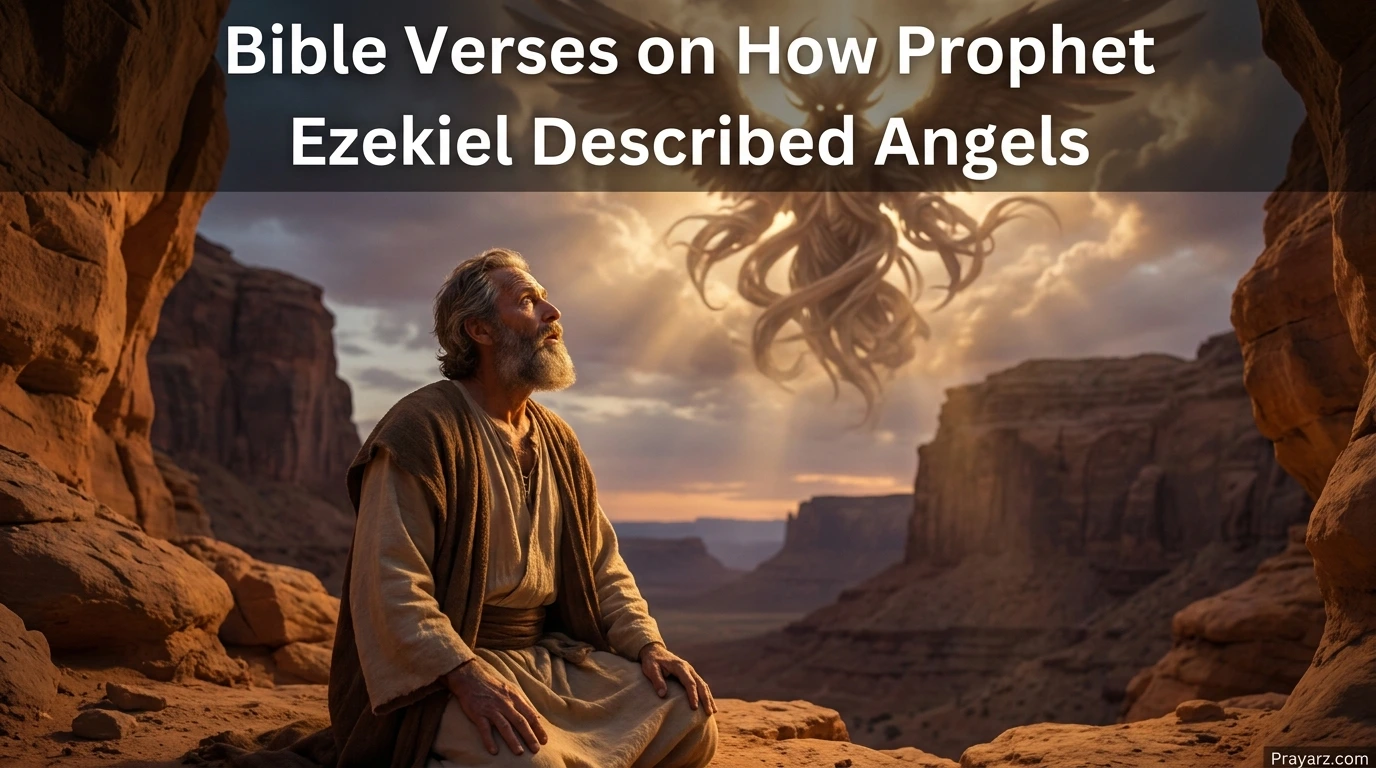
Few biblical visions are as dramatic, mysterious, and unforgettable as the opening vision of the prophet Ezekiel. He describes a stormy wind, a glowing cloud, flashes of fire, strange living creatures, enormous wheels, countless eyes, a crystal-like expanse, and a magnificent throne surrounded by radiant glory.
Because of these unusual details, many people refer to the beings in Ezekiel’s vision simply as angels. However, the biblical text uses more specific language. Ezekiel initially calls them “living creatures.” Later, in Ezekiel 10, he clearly identifies them as cherubim.
This distinction matters. The English word “angel” usually translates a Hebrew or Greek word meaning “messenger.” Cherubim, however, appear to belong to a particular order or class of heavenly beings associated with God’s holiness, throne, presence, and glory.
Ezekiel’s description is not intended merely to satisfy curiosity about the appearance of spiritual beings. Every part of the vision communicates something about God. The movement of the creatures reveals His unrestricted power. The eyes suggest complete awareness. The throne displays His authority. The fire reflects holiness and judgment. The rainbow-like radiance points toward divine glory and mercy.
To understand the vision correctly, readers must examine the verses in their literary, historical, and theological setting. Ezekiel was not writing a fantasy story. He was a prophet among exiles, delivering a serious message about judgment, God’s presence, Jerusalem’s fall, Israel’s restoration, and the absolute sovereignty of the Lord.
Quick Answer: What Did Ezekiel’s Angels Look Like?
Ezekiel described four living creatures with a human-like form. Each creature had four faces, four wings, straight legs, feet resembling a calf’s hoof, and human hands beneath its wings. Their appearance shone like polished bronze, and they moved rapidly like flashes of lightning.
Beside each creature was a large wheel that appeared to intersect another wheel. The rims of the wheels were high and covered with eyes. The wheels moved in complete harmony with the living creatures because the spirit of the creatures was in them.
Above the beings was an expanse that looked like sparkling crystal. Above that expanse stood a throne resembling sapphire. On the throne was a human-like figure surrounded by fire, brightness, and rainbow-colored radiance.
Ezekiel first calls the beings “living creatures” in Ezekiel 1. In Ezekiel 10:20, he explains that they were cherubim.
The central description appears in:
- Ezekiel 1:4–28
- Ezekiel 3:12–13
- Ezekiel 8:1–4
- Ezekiel 9:1–11
- Ezekiel 10:1–22
- Ezekiel 11:22–25
- Ezekiel 28:12–17
- Ezekiel 40:1–4
- Ezekiel 41:18–20
- Ezekiel 43:1–7
Understanding the Historical Setting of Ezekiel’s Vision
Ezekiel Was Living Among the Exiles
Ezekiel received his first recorded vision while living among Jewish exiles in Babylon. According to Ezekiel 1:1–3, he was beside the Kebar River during the fifth year of King Jehoiachin’s exile.
Jerusalem and its temple had not yet been completely destroyed, but the nation was experiencing political instability, military defeat, spiritual decline, and divine discipline. Many Judeans had already been taken to Babylon.
The exiles may have wondered whether the Lord remained with them. Since the temple stood in Jerusalem, some people may have assumed that God’s presence was restricted to that city. Ezekiel’s vision answered this concern powerfully.
God’s throne appeared in Babylon.
The Lord was not trapped inside a building. He had not lost control when His people were removed from their homeland. His rule extended over Jerusalem, Babylon, Israel, foreign nations, earthly kings, and every spiritual power.
The Vision Began With the Glory of God
Ezekiel 1 is often remembered for unusual creatures and wheels, but the chapter’s true focus is the glory of the Lord. The heavenly beings support, accompany, and serve the divine throne.
The creatures do not compete with God for attention. They point beyond themselves to the One seated above them.
At the end of the vision, Ezekiel does not fall before the wheels or worship the cherubim. He falls facedown when he sees the appearance of the Lord’s glory.
This response establishes an essential biblical principle: heavenly beings may be powerful and impressive, but worship belongs to God alone.
Ezekiel 1:4–5 — The Storm, Fire, and Four Living Creatures
Ezekiel’s vision begins with a powerful atmospheric scene. He sees a windstorm coming from the north, along with an enormous cloud, flashing fire, and brilliant light.
The center of the fire appears like glowing metal. From within this fiery brightness, four living creatures emerge.
A Windstorm From the North
The storm imagery communicates divine power and approaching judgment. In prophetic literature, the north was often associated with invading forces because armies commonly entered the land of Israel from that direction.
However, the storm in Ezekiel’s vision is more than weather or military symbolism. It announces the arrival of God’s majestic presence.
The Lord comes with overwhelming force. His appearance disrupts normal experience and commands complete attention.
Four Living Creatures
Ezekiel 1:5 introduces “four living creatures.” At this stage, the prophet does not call them angels or cherubim.
The number four may suggest completeness in relation to the created world. Scripture often uses four directions—north, south, east, and west—to represent the whole earth.
The four creatures can move in every direction, supporting the idea that God’s authority and presence are universal. No geographical limit can restrict His throne.
A Human-Like Form
Ezekiel says the creatures had the general likeness of human beings. This does not mean they looked completely human. Their structure included recognizable human characteristics, but many other features were extraordinary.
They possessed faces, hands, legs, wings, and bodies. Yet each being had four faces, four wings, unusual feet, and a shining appearance.
Ezekiel repeatedly uses words such as “likeness” and “appearance.” He is describing a heavenly reality through earthly comparisons. His language is careful because the vision exceeds ordinary human categories.
Ezekiel 1:6–10 — Four Faces, Four Wings, and Shining Feet
The most famous part of Ezekiel’s description concerns the faces and wings of the living creatures.
Each creature had:
- Four faces
- Four wings
- Straight legs
- Feet like the sole of a calf’s foot
- A polished bronze appearance
- Human hands beneath the wings
These features carry symbolic meaning, although Scripture does not provide a direct explanation for every detail.
The Face of a Human
Each creature had a human face.
The human face may point toward intelligence, reason, relationship, or humanity’s unique place within creation. Genesis teaches that human beings were created in God’s image, although the living creatures themselves are not human.
Some interpreters understand the human face as representing wisdom or the highest form of earthly life.
However, readers should distinguish interpretation from explicit biblical teaching. Ezekiel describes the face but does not directly state its symbolic meaning.
The Face of a Lion
The lion is commonly associated with strength, courage, majesty, and kingship.
In the ancient world, lions represented power and royal authority. The lion face may therefore communicate dominion over wild animals or reflect the strength with which the cherubim serve God.
The image also reminds readers that every form of earthly power remains beneath the throne of the Lord.
The Face of an Ox
The ox represents strength, endurance, labor, service, and domesticated animals.
Oxen played an important role in agriculture, transportation, sacrifice, and everyday economic life. An ox could symbolize patient strength used in service.
In Ezekiel 10:14, the corresponding face is called the face of a cherub rather than the face of an ox. Many interpreters believe these descriptions refer to the same face from different perspectives.
The Face of an Eagle
The eagle is associated with height, speed, sharp vision, and mastery of the sky.
Its inclusion may represent flying creatures or the highest realm of bird life. The eagle’s speed also fits Ezekiel’s description of the creatures moving rapidly like lightning.
Together, the human, lion, ox, and eagle faces have often been understood as representing major categories of living creation:
- Humanity
- Wild animals
- Domesticated animals
- Birds
This interpretation is possible, but it should not be presented as a direct statement from Ezekiel. The text itself lists the faces without formally explaining them.
Four Wings
Each living creature had four wings. Ezekiel 1:11 explains that two wings extended upward and touched the wings of neighboring creatures, while two wings covered the creature’s body.
The upward wings may show unity and readiness for movement. The covering wings may express reverence, humility, protection, or the concealed mystery of heavenly beings.
Their wings also produced an overwhelming sound. When the creatures moved, Ezekiel heard something like rushing waters, the voice of the Almighty, or the noise of a great army.
This was not a soft or delicate sound. Their movement expressed tremendous power.
Human Hands Beneath the Wings
Ezekiel 1:8 says the creatures had human hands under their wings.
Hands commonly represent action, service, skill, and the ability to carry out commands. The detail suggests that these beings were not abstract forces. They were active servants capable of performing God’s will.
In Ezekiel 10:7, one cherub reaches into the fire and gives burning coals to the man dressed in linen. The human-like hand is therefore connected with purposeful action.
Straight Legs and Calf-Like Feet
The creatures’ legs were straight, and the soles of their feet resembled the feet of a calf. Their feet sparkled like polished bronze.
Straight legs may indicate stability and direct movement. The creatures did not stumble or move uncertainly.
The polished bronze appearance communicates brightness, strength, purity, and supernatural radiance. Biblical visions frequently use glowing metal to describe heavenly glory or intense divine brilliance.
Ezekiel 1:9–14 — How the Living Creatures Moved
Ezekiel’s creatures did not move like ordinary animals or human beings. They traveled in perfect unity and never needed to turn their bodies.
They Moved Straight Ahead
Each creature moved in the direction faced by one of its four faces. Because each had a face pointing in every direction, the beings could travel north, south, east, or west without turning around.
This detail communicates unrestricted movement. God’s throne is not limited by roadways, geography, physical obstacles, or human boundaries.
Wherever the Spirit directed, the creatures went.
They Followed the Spirit
Ezekiel 1:12 explains that the living creatures moved wherever the spirit directed them.
The verse emphasizes complete obedience. They did not act independently or resist God’s direction. Their movements reflected the purpose of the divine presence above them.
This offers an important spiritual contrast. Human beings often hesitate, question, delay, or turn away from God’s commands. The heavenly creatures respond immediately and completely.
Fire Moved Among Them
Their appearance resembled burning coals or flaming torches. Fire moved back and forth among them, producing brightness and flashes of lightning.
Throughout Scripture, fire is connected with several themes:
- God’s holiness
- Divine presence
- Purification
- Judgment
- Power
- Revelation
In Ezekiel’s setting, fire particularly prepares readers for the judgment coming upon Jerusalem. Later, burning coals are taken from among the cherubim and scattered over the city.
They Moved Like Lightning
Ezekiel 1:14 compares the creatures’ movement to flashes of lightning.
The image communicates speed, brilliance, energy, and immediate response. Nothing about their service is slow or confused.
Their swift movement also reveals that the Lord can act without delay. His purposes are not hindered by distance.
Ezekiel 1:15–21 — The Wheels Within Wheels
Beside each living creature, Ezekiel saw a remarkable wheel touching the ground.
The wheels have become one of the most discussed parts of his vision. They are sometimes called “wheel angels” or “ophanim” in modern discussions. However, careful biblical interpretation requires more precise language.
A Wheel Beside Each Creature
Ezekiel saw one wheel beside each of the four creatures.
The wheels appeared to shine like a precious stone, often translated as beryl, topaz, chrysolite, or tarshish stone, depending on the Bible translation.
Their radiant appearance confirms that they belong to the heavenly throne vision rather than an ordinary earthly vehicle.
A Wheel Intersecting Another Wheel
Ezekiel says the structure appeared like “a wheel within a wheel.”
The exact mechanical form is difficult to imagine. It may describe two wheels crossing at right angles, allowing movement in any direction without turning.
The main point is clear: the throne’s movement was unrestricted. It could travel in any direction immediately.
This imagery should not be reduced to a modern machine diagram. Ezekiel is communicating the supernatural freedom, stability, and mobility of God’s throne.
High and Awesome Rims
The rims were so high that Ezekiel found them overwhelming or awesome.
Their enormous size contributes to the sense of majesty. The prophet is seeing something beyond normal human scale.
The wheels are not small decorations beneath the creatures. They are magnificent components of the throne vision.
Rims Full of Eyes
Ezekiel 1:18 says the rims were covered with eyes.
Eyes often symbolize knowledge, awareness, watchfulness, or perception. The image may communicate that God’s rule operates with complete awareness.
Nothing in Jerusalem, Babylon, or the surrounding nations was hidden from Him. He saw idolatry in secret rooms, violence in the city, corruption among leaders, and the suffering of faithful people.
The eyes do not necessarily mean the wheels were independent creatures. Ezekiel describes them as components moving with the living beings.
The Spirit of the Living Creatures Was in the Wheels
The wheels rose when the creatures rose and stopped when the creatures stopped. Ezekiel explains this coordination by saying the spirit of the living creatures was in the wheels.
There was no disorder between the creatures and the wheels. They functioned as one unified throne-bearing structure.
Their complete harmony reflects the order of God’s heavenly rule.
Are the Wheels Angels?
The text does not directly call the wheels angels.
Later Jewish mystical traditions developed the concept of ophanim, a term related to the Hebrew word for wheels. In some classifications, ophanim became understood as a distinct order of heavenly beings.
However, Ezekiel himself describes wheels associated with the cherubim and the divine throne. Readers should therefore avoid confidently claiming that the wheels are a separate angelic species unless they clearly identify that idea as a later interpretation.
Ezekiel 1:22–25 — The Crystal-Like Expanse
Above the heads of the living creatures was something resembling an expanse, platform, or vault.
Ezekiel compares it to shining crystal. It appeared magnificent and awe-inspiring.
A Boundary Between the Creatures and the Throne
The expanse separates the living creatures below from the throne above.
This arrangement establishes a clear order:
- Wheels touch the earth.
- Living creatures stand beside the wheels.
- The expanse rests above the creatures.
- The throne stands above the expanse.
- The divine figure is seated on the throne.
The structure directs the reader’s attention upward toward God.
Wings That Became Silent
When the creatures moved, their wings produced a mighty sound. When they stopped, they lowered their wings.
Then a voice came from above the expanse.
The heavenly beings became still when the One above them spoke. Their silence demonstrates submission to divine authority.
Even the most powerful creatures in the vision remain servants beneath God’s throne.
Ezekiel 1:26–28 — The Throne and the Glory of the Lord
The climax of Ezekiel’s vision is not the four faces, the wings, or the wheels. It is the appearance above them.
A Throne Like Sapphire
Above the expanse, Ezekiel saw something resembling a throne made of sapphire or lapis lazuli.
The deep blue appearance suggests heavenly majesty, beauty, and royal authority.
A throne represents government, judgment, kingship, and supreme rule. Ezekiel’s people may have been defeated politically, but their God remained King.
Babylonian rulers controlled an empire, yet the Lord ruled above every earthly government.
A Human-Like Figure
On the throne was a figure with the appearance of a human being.
Ezekiel does not claim that God is merely human. Once again, he uses careful language such as “appearance” and “likeness.”
From the waist upward, the figure looked like glowing metal surrounded by fire. From the waist downward, Ezekiel saw fire and brilliant light.
The human-like appearance makes the divine presence personal and recognizable while preserving mystery.
Radiance Like a Rainbow
The brightness surrounding the throne resembled a rainbow appearing in the clouds after rain.
The rainbow recalls God’s covenant with Noah in Genesis 9. It may therefore suggest mercy, covenant faithfulness, beauty, and hope amid judgment.
Ezekiel’s ministry contained severe warnings, but judgment was not the final message. God also promised restoration, cleansing, renewed hearts, a new spirit, and a restored relationship with His people.
Ezekiel Fell Facedown
When Ezekiel saw the glory of the Lord, he fell facedown.
His response shows reverence, fear, humility, and recognition of divine holiness.
The prophet did not treat the vision casually. He understood that he stood before a revelation of overwhelming majesty.
God then spoke to him and commissioned him as a prophet.
Ezekiel 3:12–13 — The Sound of the Cherubim’s Wings
After Ezekiel received his prophetic commission, the Spirit lifted him.
He heard a great rumbling sound behind him. The noise came from the wings of the living creatures touching one another and from the wheels beside them.
This passage confirms that the creatures and wheels continued to accompany the manifestation of God’s glory.
Their sound marked the movement of the heavenly throne. Ezekiel was not simply remembering an earlier image. The divine presence actively directed his prophetic mission.
The passage also shows that receiving God’s message did not immediately make Ezekiel emotionally comfortable. He went in bitterness and distress, while the strong hand of the Lord remained upon him.
A genuine heavenly encounter may bring awe and responsibility rather than entertainment.
Ezekiel 8:1–4 — The Return of the Throne Vision
In Ezekiel 8, the prophet again sees an appearance connected with the earlier vision.
He describes a figure resembling fire, glowing metal, or radiant brightness. A hand-like form reaches out and lifts him by the hair. The Spirit carries him in visions to Jerusalem.
There he sees the glory of the God of Israel, like the vision he had seen in the plain.
Was This Figure an Angel?
The passage does not explicitly identify the fiery figure as an angel.
Some readers understand it as an angelic representative. Others view it as a manifestation associated directly with God’s glory.
Because the text does not clearly name the figure, it is best to describe it as a heavenly or divine appearance rather than assigning a definite angelic classification.
This interpretive caution helps readers distinguish biblical statements from later assumptions.
Ezekiel 9:1–11 — The Men With Weapons and the Man in Linen
Ezekiel 9 introduces seven human-like heavenly figures.
Six carry weapons of judgment. A seventh man is dressed in linen and carries a writing case.
Six Men With Destructive Weapons
The six figures approach from the direction of the upper gate.
They are described as men, but their role, entrance, and obedience to the divine command suggest heavenly agents of judgment.
The Bible does not explicitly call them angels in this chapter. Nevertheless, many interpreters understand them as supernatural messengers or executors of God’s judgment.
The Man Dressed in Linen
The man in linen receives a special assignment. He must pass through Jerusalem and place a mark on the foreheads of people grieving over the city’s sins.
The others are told to follow him and execute judgment, but they must not touch anyone bearing the mark.
Linen clothing is frequently connected with priestly service, purity, or heavenly ministry. Similar linen-clothed figures appear in other biblical visions, including Daniel 10 and 12.
God Knows Those Who Remain Faithful
The marking scene communicates divine awareness and discrimination.
God did not judge carelessly. He knew who supported the city’s corruption and who mourned over it.
This theme connects with the eyes covering the wheels and cherubim. The Lord sees completely and judges with perfect knowledge.
Ezekiel 10:1–2 — Burning Coals From Among the Cherubim
Ezekiel 10 returns directly to the throne vision.
Above the expanse over the cherubim, Ezekiel sees something like a sapphire throne. The Lord commands the man dressed in linen to go between the wheels and take burning coals from among the cherubim.
He must scatter the coals over Jerusalem.
Fire as a Sign of Judgment
The fire that appeared in Ezekiel 1 now becomes an instrument of judgment.
Jerusalem had been filled with idolatry, violence, injustice, and covenant unfaithfulness. The scattering of coals announces the coming destruction of the city.
This action reveals that the heavenly throne is not merely decorative. God actively governs history and executes justice.
A Cherub Gives the Coals
The man in linen enters the space among the wheels. One cherub reaches out its hand, takes fire from among the cherubim, and places it into the man’s hands.
This action confirms the significance of the human-like hands previously mentioned in Ezekiel 1:8.
The cherubim carry out God’s commands with accuracy and purpose.
Ezekiel 10:8–14 — Eyes, Wings, Hands, and Four Faces
Ezekiel provides another detailed description of the cherubim in chapter 10.
Their wings, hands, bodies, wheels, and faces reappear.
Bodies and Wheels Full of Eyes
Ezekiel 10:12 expands the eye imagery. The bodies, backs, hands, wings, and wheels are described as being full of eyes.
The image creates a powerful sense of complete perception.
The Lord’s heavenly throne is not blind, careless, or uninformed. God’s servants carry out His will under perfect divine awareness.
The Four Faces in Ezekiel 10
Ezekiel 10:14 lists the faces as:
- The face of a cherub
- The face of a human being
- The face of a lion
- The face of an eagle
In Ezekiel 1:10, the first face in the corresponding list is an ox.
Scholars and interpreters have proposed several explanations. The simplest is that the face called an ox in chapter 1 is described as a cherub’s face in chapter 10.
Ancient cherubim may have been associated with bovine features. The change in wording does not necessarily mean Ezekiel saw different creatures.
Each Creature Moved Straight Ahead
As in chapter 1, the cherubim moved without turning.
The direction of the leading face determined the movement of the whole throne structure.
The repeated detail reinforces God’s unrestricted mobility and the unity of His heavenly servants.
Ezekiel 10:15–22 — Ezekiel Identifies the Creatures as Cherubim
The clearest identification appears in Ezekiel 10:20.
Ezekiel says these were the living creatures he had seen beneath the God of Israel by the Kebar River, and he knew that they were cherubim.
This verse is essential for interpreting the earlier vision.
Living Creatures and Cherubim Are the Same Beings
The four living creatures of Ezekiel 1 are not a separate category from the cherubim in Ezekiel 10.
Ezekiel directly connects them:
- Same four creatures
- Same four faces
- Same four wings
- Same human-like hands
- Same wheels
- Same coordinated movement
- Same connection with God’s glory
Therefore, “living creatures” describes how they appeared, while “cherubim” identifies what they were.
Cherubim Are More Than Decorative Babies
Popular Western art sometimes portrays cherubs as small, winged children. That image comes largely from later artistic traditions rather than Ezekiel’s vision.
Biblical cherubim are powerful, awe-inspiring guardians associated with God’s throne and holy presence.
They appear in several important biblical settings:
- Guarding the way to the tree of life in Genesis 3:24
- Formed above the Ark of the Covenant in Exodus 25:18–22
- Woven into the tabernacle curtains in Exodus 26
- Connected with God’s throne in the Psalms
- Supporting the divine throne in Ezekiel
- Carved into the temple vision in Ezekiel 41
Ezekiel’s cherubim should therefore be understood within this larger biblical pattern.
Ezekiel 11:22–25 — The Glory Departs From Jerusalem
In Ezekiel 11, the cherubim lift their wings, and the wheels move beside them.
The glory of the God of Israel remains above them as the throne rises from the city.
The glory stops over the mountain east of Jerusalem before the vision ends.
The Departure Was a Sign of Judgment
God’s glory leaving the temple was one of the most tragic moments in Ezekiel’s prophecy.
The temple was meant to represent God’s dwelling among His people. Yet persistent idolatry, violence, corruption, and rebellion had polluted the city.
The Lord’s departure showed that the temple building could not protect people who rejected the God it represented.
God Was Still Present With the Exiles
Although the glory departed Jerusalem, God had not abandoned every faithful person.
Ezekiel 11:16 says the Lord would be a sanctuary for the exiles in the countries where they had gone.
The mobile throne vision supported this promise. God could be present with His people even outside Jerusalem.
The cherubim and wheels illustrated that His presence was not geographically trapped.
Ezekiel 28:12–17 — The Guardian Cherub in the Lament Over Tyre
Ezekiel 28 contains a lament addressed to the king of Tyre.
The language describes beauty, wisdom, Eden, precious stones, pride, corruption, and an anointed guardian cherub.
The Immediate Context Concerns the King of Tyre
The prophecy directly addresses a proud earthly ruler.
Tyre was a wealthy commercial power, and its king had become arrogant because of prosperity, political influence, and perceived security.
Ezekiel uses elevated poetic language to expose the ruler’s pride and coming downfall.
Is This Passage About Satan?
Many Christian interpreters have understood Ezekiel 28 as containing a secondary reference to Satan’s original fall. The language about Eden, perfection, a guardian cherub, pride, and expulsion has contributed to this interpretation.
Other scholars understand the entire passage as symbolic language describing the king of Tyre. In this reading, the king is compared to a privileged heavenly or Edenic figure who fell because of pride.
The text’s immediate subject is the king of Tyre. Any connection to Satan should therefore be presented as a theological interpretation rather than the only possible reading.
The Guardian Role of Cherubim
Regardless of the interpretive position, the passage associates a cherub with sacred space, beauty, responsibility, and proximity to God.
The figure’s corruption results in expulsion and judgment.
This reinforces a biblical theme: privilege does not excuse pride, rebellion, or violence.
Ezekiel 40:1–4 — The Bronze-Like Man With a Measuring Rod
Near the end of Ezekiel’s book, the prophet receives a vision of a restored temple.
At the entrance, he sees a man whose appearance resembles bronze. The figure holds a linen cord and a measuring rod.
A Heavenly Guide
The man instructs Ezekiel to watch carefully, listen closely, and report everything he sees to Israel.
He then guides the prophet through the temple complex and measures its structures.
This figure functions like a heavenly messenger, guide, and interpreter.
Is the Measuring Man an Angel?
Ezekiel calls him a man rather than an angel.
However, his radiant appearance, supernatural role, and authority within the vision lead many readers to understand him as an angelic guide.
A similar measuring figure appears in Zechariah 2, while an angel measures the New Jerusalem in Revelation 21.
Once again, the safest wording is that Ezekiel saw a heavenly guide with the appearance of a man.
Ezekiel 41:18–20 — Two-Faced Cherubim in the Temple
Ezekiel’s temple vision includes carved cherubim and palm trees on the walls.
These carved cherubim differ from the living cherubim in chapters 1 and 10.
Each Carved Cherub Had Two Faces
One face looked toward the palm tree on one side, and the other face looked toward the palm tree on the opposite side.
The two faces were:
- A human face
- A lion’s face
These images were architectural decorations rather than a new vision of living heavenly beings.
Why Are These Cherubim Different?
Biblical artistic representations of cherubim do not always display every feature of Ezekiel’s throne vision.
The cherubim above the Ark of the Covenant, for example, are described with wings but not four faces.
The temple carvings have two visible faces because they are designed for a wall pattern.
Readers should therefore avoid assuming that every biblical cherub must always appear with four faces and four wings. Ezekiel’s living cherubim were seen in a particular prophetic throne vision.
What Do Ezekiel’s Cherubim Represent?
The Bible does not provide a simple key explaining every feature. Nevertheless, the vision clearly communicates several major truths.
God’s Universal Authority
The creatures can move in every direction. The wheels also travel without turning.
This unrestricted movement shows that God’s rule extends everywhere.
He is not a local deity limited to Jerusalem. He reigns over Israel, Babylon, Tyre, Egypt, and every other nation.
God’s Complete Knowledge
The many eyes suggest awareness, perception, and watchfulness.
God saw the sins hidden within Jerusalem’s temple. He also saw the people grieving over those sins.
His judgment was based on perfect knowledge rather than incomplete information.
God’s Perfect Order
The creatures, wings, wheels, and Spirit move together.
Nothing collides, hesitates, or becomes confused.
The throne vision reveals harmony under divine authority. God’s government is purposeful and ordered even when earthly events appear chaotic.
God’s Holiness
Fire, brightness, crystal, glowing metal, and overwhelming sound communicate holiness and majesty.
God’s presence is beautiful, but it is not ordinary or casual.
Ezekiel’s response was to fall facedown.
God’s Freedom of Movement
The wheels show that God’s throne can move.
This truth was especially important to the exiles. The Lord could leave a polluted temple, appear in Babylon, accompany His people in exile, and later restore them.
No nation, temple, ruler, or geographical boundary could control Him.
God’s Judgment and Mercy
The fire among the cherubim becomes a sign of judgment upon Jerusalem.
Yet the rainbow-like radiance surrounding the throne recalls covenant mercy.
Ezekiel’s message contains both warning and hope. God judges rebellion, but He also promises restoration to a cleansed and renewed people.
Cherubim, Angels, Seraphim, and Living Creatures
Biblical discussions sometimes treat every heavenly being as though it belonged to one identical group. Scripture presents a more varied picture.
Angels
The biblical words commonly translated “angel” mean messenger.
Angels frequently deliver messages, protect people, worship God, carry out judgment, or provide guidance.
They often appear in human-like form, although their true nature is spiritual.
Cherubim
Cherubim are associated with:
- God’s throne
- Sacred space
- Divine presence
- Protection of holiness
- The Ark of the Covenant
- The Garden of Eden
- Temple imagery
Ezekiel’s four living creatures are explicitly identified as cherubim.
Seraphim
Seraphim appear by name in Isaiah 6.
Each seraph has six wings:
- Two covering the face
- Two covering the feet
- Two used for flying
They proclaim God’s holiness and serve around His throne.
Isaiah’s seraphim should not automatically be identified with Ezekiel’s cherubim. Their descriptions overlap in their connection with God’s throne, but their names and features differ.
Living Creatures in Revelation
Revelation 4 describes four living creatures around God’s throne.
One resembles a lion, one an ox, one a human being, and one an eagle. They are covered with eyes and each has six wings.
John’s description combines features resembling Ezekiel’s cherubim and Isaiah’s seraphim.
The four beings in Revelation continually worship God and proclaim His holiness.
The similarity shows a strong biblical connection, but Revelation’s creatures are not described in exactly the same way as Ezekiel’s.
Common Misunderstandings About Ezekiel’s Angels
Misunderstanding One: Every Biblical Angel Looks Like Ezekiel’s Creatures
The Bible presents heavenly beings in different ways.
Many angels appear as men. Cherubim are associated with God’s throne. Seraphim have six wings. Some heavenly visions include symbolic creatures.
Ezekiel’s description should not be used as the appearance of every angel mentioned in Scripture.
Misunderstanding Two: The Wheels Are Clearly a Separate Angelic Species
Ezekiel describes wheels beside the cherubim, moving in unity with them.
Later traditions may classify ophanim as a heavenly order, but Ezekiel does not directly introduce the wheels as independent angels.
It is more accurate to call them the living wheels of the throne vision.
Misunderstanding Three: Cherubim Are Small Winged Babies
This popular image does not match Ezekiel’s description.
His cherubim are powerful, radiant, many-eyed, four-faced throne bearers.
The baby-like cherub developed through later artistic traditions.
Misunderstanding Four: Ezekiel Saw God’s Exact Physical Form
Ezekiel repeatedly speaks of likeness and appearance.
He describes what the vision looked like to him without claiming to define God’s complete nature.
The vision communicates divine glory through symbolic and understandable images.
Misunderstanding Five: The Vision Was Mainly About Strange Creatures
The central subject is God’s glory.
The creatures, wheels, eyes, fire, and throne all direct attention toward the Lord’s authority, holiness, knowledge, mobility, judgment, and mercy.
Practical Spiritual Lessons From Ezekiel’s Vision
God Is Present Beyond Familiar Places
The Lord appeared to Ezekiel in exile.
God was not limited to Jerusalem, the temple, or Israel’s national borders.
Believers can remember this truth during displacement, uncertainty, loneliness, or major life changes. God’s presence is not restricted by location.
God Sees What Human Beings Cannot See
The eyes in the vision remind readers that nothing is hidden from God.
He sees public actions, private motives, injustice, grief, faithfulness, and repentance.
This truth offers both warning and comfort. Hidden wrongdoing is known to Him, but hidden faithfulness is also seen.
God Remains Sovereign During Political Upheaval
Ezekiel lived during war, exile, national collapse, and political confusion.
Yet his first major vision was a vision of God on the throne.
Earthly governments rise and fall, but divine authority remains.
Holiness Should Produce Reverence
Ezekiel fell facedown when he encountered the Lord’s glory.
Modern readers should resist treating heavenly visions as entertainment alone.
The proper response includes humility, worship, obedience, repentance, and awe.
God’s Servants Respond to His Direction
The cherubim went wherever the Spirit directed.
Their obedience was complete and immediate.
They provide a powerful image of service aligned with God’s purpose.
Judgment Does Not Cancel Hope
Ezekiel announced Jerusalem’s destruction, but he also proclaimed restoration.
The same book contains promises of:
- A new heart
- A new spirit
- Cleansing
- National restoration
- Renewed worship
- God’s presence among His people
The radiant rainbow around the throne reminds readers that mercy remains part of God’s character even during judgment.
Key Bible Verses About Ezekiel’s Heavenly Beings
Ezekiel 1:5–6
Four living creatures emerged from the fiery cloud. Each had a human-like form, four faces, and four wings.
Ezekiel 1:7–8
Their legs were straight, their feet resembled calf hooves, and they shone like polished bronze. Human hands appeared beneath their wings.
Ezekiel 1:10
Each creature had the face of a human, lion, ox, and eagle.
Ezekiel 1:12
They moved straight ahead wherever the Spirit directed them.
Ezekiel 1:13–14
Their appearance resembled burning coals, and they moved like flashes of lightning.
Ezekiel 1:15–18
A wheel stood beside each creature. The wheels intersected one another, and their high rims were covered with eyes.
Ezekiel 1:20–21
The wheels moved and rose with the creatures because the spirit of the living creatures was in them.
Ezekiel 1:22
A crystal-like expanse stretched above the creatures’ heads.
Ezekiel 1:24
The sound of their wings resembled rushing waters, the voice of the Almighty, and the noise of an army.
Ezekiel 1:26–28
A sapphire-like throne stood above them. A human-like figure surrounded by fire and rainbow-colored radiance sat upon it.
Ezekiel 3:12–13
He heard the rumbling wings of the living creatures and the sound of the wheels beside them.
Ezekiel 9:2–4
Six armed men appeared with a seventh man dressed in linen and carrying a writing case.
Ezekiel 10:2
The man dressed in linen was commanded to take burning coals from among the cherubim.
Ezekiel 10:8
The cherubim had what appeared to be human hands under their wings.
Ezekiel 10:12
The cherubim’s bodies, backs, hands, wings, and wheels were full of eyes.
Ezekiel 10:14
Each had four faces: a cherub, a human being, a lion, and an eagle.
Ezekiel 10:20
He identified the living creatures seen by the Kebar River as cherubim.
Ezekiel 11:22–23
The cherubim lifted their wings as the glory of the Lord rose and departed from Jerusalem.
Ezekiel 28:14
The lament over the king of Tyre refers to an anointed guardian cherub.
Ezekiel 40:3–4
A bronze-like man carrying a measuring cord and rod guided Ezekiel through the temple vision.
Ezekiel 41:18–20
Carved cherubim with human and lion faces decorated the walls of the visionary temple.
How to Study Ezekiel’s Vision Carefully
Read Chapters 1 and 10 Together
Ezekiel 1 introduces the living creatures.
Ezekiel 10 identifies them as cherubim and provides further details. Reading only one chapter may leave important questions unanswered.
Follow the Movement of God’s Glory
The glory appears among the exiles, enters the temple vision, rises from the cherubim, leaves the temple, and later returns in Ezekiel 43.
This movement is central to the book’s message.
Separate the Text From Artistic Traditions
Paintings, internet illustrations, films, and social media posts may exaggerate or combine biblical descriptions.
Return to the verses and note exactly what Ezekiel says.
Distinguish Description From Interpretation
Ezekiel states that the creatures had four faces. He does not explicitly explain what each face symbolizes.
Interpretive traditions may be helpful, but they should not be presented as though they were direct quotations from Scripture.
Keep God at the Center
The creatures serve the throne.
The purpose of the vision is to reveal the glory and sovereignty of God, not to encourage obsession with supernatural beings.
Frequently Asked Questions
How did Ezekiel describe angels?
Ezekiel described four living creatures with human-like bodies, four faces, four wings, straight legs, calf-like feet, human hands, and a shining bronze appearance. They moved like lightning and traveled without turning.
Large intersecting wheels stood beside them. The rims were high and full of eyes. Above the creatures was a crystal-like expanse supporting a sapphire-like throne.
Ezekiel later identified the living creatures as cherubim in Ezekiel 10:20.
Did Ezekiel call the creatures angels?
Ezekiel initially called them living creatures and later identified them as cherubim.
The word “angel” is often used broadly for heavenly beings, but Ezekiel uses the more specific term “cherubim.”
Therefore, it is understandable to discuss them within the subject of biblical angels, but the most precise biblical identification is cherubim.
Why did Ezekiel’s cherubim have four faces?
Ezekiel does not directly explain the meaning of the four faces.
Many interpreters understand them as representing major categories of created life: humanity, wild animals, domesticated animals, and birds.
Others associate the faces with qualities such as wisdom, strength, service, and speed.
These meanings are interpretations rather than explanations explicitly provided by Ezekiel.
What were the four faces?
In Ezekiel 1, each creature had the face of:
- A human being
- A lion
- An ox
- An eagle
In Ezekiel 10, the corresponding list includes the face of a cherub instead of an ox. Many interpreters believe the cherub face was ox-like.
Why did the creatures have four wings?
Two wings extended upward and touched the wings of neighboring creatures. Two covered each creature’s body.
Their wings allowed movement, expressed unity, and produced a sound like rushing waters or a great army.
The covering wings may also suggest reverence or humility before God, although Ezekiel does not directly explain their meaning.
What does the wheel within a wheel mean?
The intersecting wheels allowed movement in every direction without turning.
They communicate the unrestricted mobility of God’s throne. The Lord could move anywhere and was not confined to Jerusalem or its temple.
The wheels also moved in perfect unity with the cherubim.
Why were the wheels covered with eyes?
Eyes commonly represent perception, watchfulness, and knowledge.
The many eyes may symbolize God’s complete awareness. Nothing in Jerusalem, Babylon, or the wider world escaped His notice.
Ezekiel does not provide a formal symbolic explanation, so this meaning should be understood as a strong interpretive conclusion rather than a direct definition.
Are the wheels called ophanim?
The Hebrew word for wheel is related to the term often rendered ophan, with ophanim as a plural form.
Later Jewish traditions developed ophanim as an order of heavenly beings.
Ezekiel, however, describes wheels connected to the cherubim and God’s throne. He does not clearly present them as a separate class of angels.
Were the cherubim themselves covered with eyes?
Ezekiel 1 specifically describes the wheel rims as full of eyes.
Ezekiel 10:12 expands the description by saying the cherubim’s bodies, backs, hands, wings, and wheels were full of eyes.
This imagery emphasizes extraordinary awareness and the all-seeing nature of God’s heavenly rule.
Are Ezekiel’s cherubim the same as Isaiah’s seraphim?
They share certain similarities because both serve near God’s throne.
However, Isaiah calls his beings seraphim and describes each one with six wings. Ezekiel calls his beings cherubim and describes each one with four wings and four faces.
They may represent different classes of heavenly beings.
Are Ezekiel’s creatures the same as those in Revelation?
Revelation 4 contains strong similarities to Ezekiel and Isaiah.
John sees four living creatures resembling a lion, ox, human being, and eagle. They are full of eyes and have six wings.
The Revelation creatures combine features found in Ezekiel’s cherubim and Isaiah’s seraphim. They share the role of serving and worshipping around God’s throne, but their descriptions are not completely identical.
Was the human-like figure on the throne an angel?
The figure on the throne represents the appearance of the glory of the Lord.
Ezekiel does not identify the enthroned figure as an angel.
The cherubim serve beneath the throne, while the divine figure sits above them. This distinction shows the difference between the Creator and His heavenly servants.
Who was the man dressed in linen?
The man dressed in linen appears in Ezekiel 9 and 10.
He marks faithful mourners in Jerusalem and later receives burning coals from among the cherubim.
The text calls him a man rather than an angel, but his supernatural role leads many interpreters to regard him as a heavenly messenger or angelic servant.
Who was the bronze-like man in Ezekiel 40?
The bronze-like man guided Ezekiel through the restored temple and measured its structures.
He functioned as a heavenly guide and interpreter.
Although Ezekiel calls him a man, his appearance and role suggest that he was a supernatural messenger.
Why was God’s throne able to move?
The mobile throne showed that God was not restricted to the Jerusalem temple.
He could appear among the exiles in Babylon, depart from a corrupted sanctuary, judge nations, accompany His people, and later return in glory.
The wheels and cherubim displayed His universal sovereignty.
What was the main message of Ezekiel’s vision?
The main message was that the glory, holiness, authority, knowledge, and presence of God extend everywhere.
The Lord remained sovereign even when Jerusalem was threatened and His people were in exile.
The vision also prepared Ezekiel for his prophetic mission of warning, judgment, repentance, hope, and restoration.
Should Ezekiel’s vision be understood literally or symbolically?
The vision describes a real revelation experienced by Ezekiel, but it uses highly symbolic and comparative language.
The prophet repeatedly says something had the “appearance” or “likeness” of an earthly object.
Readers do not need to choose between a meaningless symbol and a completely ordinary physical object. Ezekiel saw a genuine heavenly vision communicated through images he could describe using human language.
What can Christians learn from Ezekiel’s cherubim?
The cherubim demonstrate obedience, unity, readiness, and complete submission to God’s direction.
Their position beneath the throne reminds believers that all created beings remain under God’s authority.
The vision also encourages reverence. God is near and merciful, but He is also holy, majestic, and worthy of worship.
Conclusion
Ezekiel’s vision offers one of Scripture’s most detailed descriptions of heavenly beings. He saw four living creatures with human-like forms, four faces, four wings, straight legs, shining feet, and hands beneath their wings. Beside them were intersecting wheels with high rims covered in eyes.
The creatures moved with extraordinary speed and perfect unity. They followed the direction of the Spirit and supported the magnificent throne above them. Ezekiel later identified them as cherubim, linking them with the wider biblical theme of heavenly guardians surrounding God’s holy presence.
Yet the strange features of the cherubim are not the final focus. Above the creatures, wheels, and crystal-like expanse stood the throne of the Lord. God’s radiant glory caused Ezekiel to fall facedown.
The vision assured the exiles that God remained present and sovereign. He was not confined to Jerusalem, defeated by Babylon, or unaware of His people’s suffering. His throne could move wherever He desired, His eyes saw everything, and His purposes continued without interruption.
For modern readers, Ezekiel’s description should inspire more than curiosity. It calls us to recognize God’s holiness, trust His authority, obey His direction, and worship Him with humility. The cherubim are impressive, but their purpose is to direct our attention upward—to the eternal King whose glory fills heaven and earth.
