
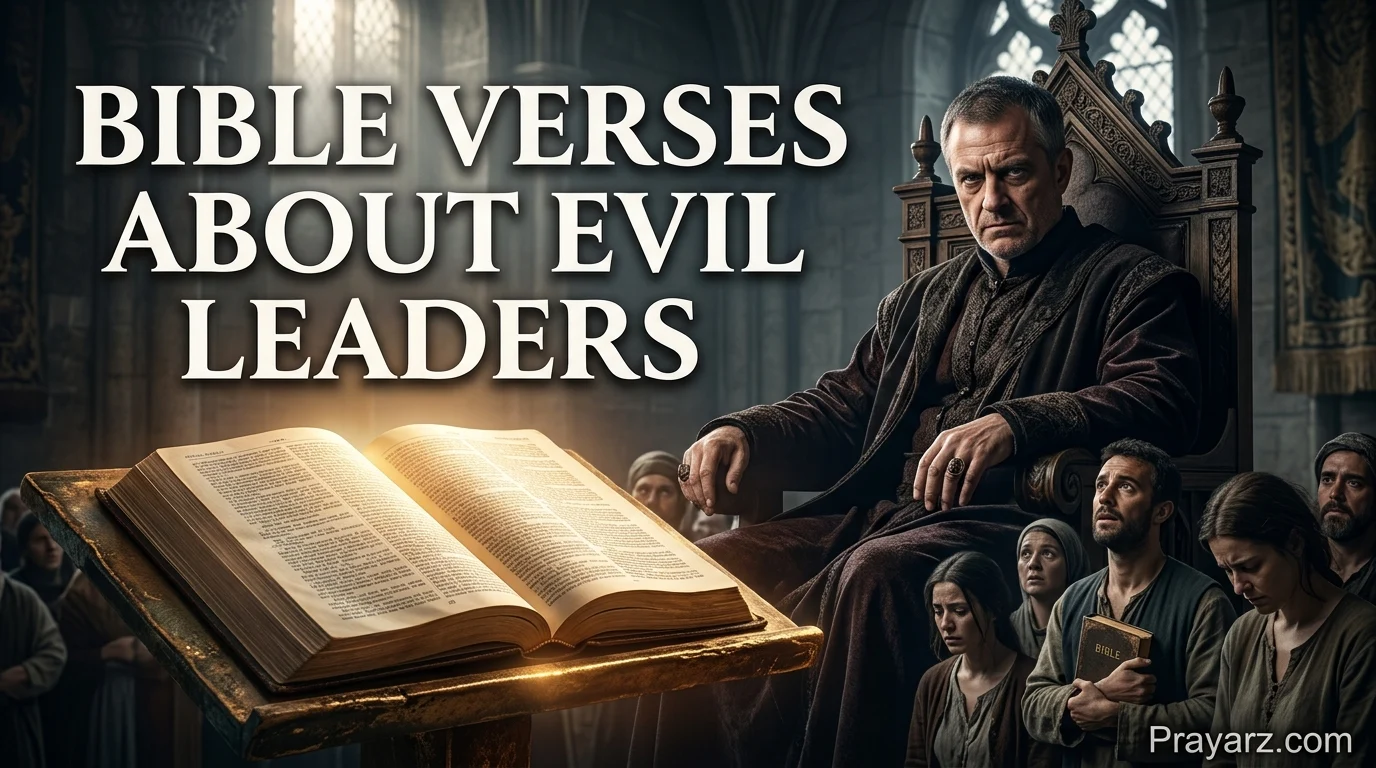
Throughout history, people have lived under leaders who abused power, promoted injustice, oppressed the weak, or turned away from God’s truth. From ancient kings and rulers to modern governments and authorities, the reality of evil leadership has affected countless lives. Many believers ask important questions: What does the Bible say about evil leaders? How should Christians respond when leaders are corrupt? Does God hold wicked rulers accountable?
The good news is that Scripture does not ignore these concerns. The Bible speaks openly about unrighteous rulers, corrupt authorities, and leaders who misuse their positions. At the same time, it reveals God’s sovereignty over every kingdom, nation, and government. No leader is beyond His authority, and no injustice escapes His notice.
As we study Bible verses about evil leaders, we discover timeless truths about God’s justice, righteous leadership, prayer, wisdom, endurance, and hope. These passages remind us that while earthly leaders may fail, God remains the perfect King whose rule is righteous forever.
Let these Scriptures strengthen your faith and help you trust God’s plan even when leadership around you seems unjust or ungodly.
What Does the Bible Say About Evil Leaders?
The Bible presents a realistic picture of leadership. While God establishes authority for order and justice, leaders are still human and capable of sin. Scripture records numerous examples of rulers who rejected God’s ways and harmed those under their care.
From Pharaoh in Egypt to King Ahab in Israel, from Babylonian kings to Roman authorities, the Bible shows that evil leadership has existed throughout history.
Yet one truth remains constant: God ultimately rules over all earthly authorities.
Daniel 2:21
“And he changeth the times and the seasons: he removeth kings, and setteth up kings.”
This verse reminds believers that God remains sovereign over governments and rulers. Leaders may appear powerful, but their authority exists only because God permits it.
When evil leaders rise to power, Christians can find peace knowing that God still reigns from heaven.
God Condemns Unjust and Wicked Rulers
One of the strongest themes in Scripture is God’s opposition to injustice. Leaders are expected to protect people, uphold truth, and promote righteousness. When they do the opposite, God takes notice.
Proverbs 29:2
“When the righteous are in authority, the people rejoice: but when the wicked beareth rule, the people mourn.”
This verse captures a universal truth. Good leadership brings blessing, peace, and stability. Wicked leadership creates suffering, fear, and hardship.
The mourning mentioned here reflects the pain experienced by people living under corrupt rule.
Isaiah 10:1–2
“Woe unto them that decree unrighteous decrees, and that write grievousness which they have prescribed; To turn aside the needy from judgment, and to take away the right from the poor of my people.”
God specifically condemns leaders who create unjust laws and exploit vulnerable people.
This passage reveals God’s heart for justice and His concern for the oppressed.
Ezekiel 34:2
“Woe be to the shepherds of Israel that do feed themselves! should not the shepherds feed the flocks?”
Although this passage addresses spiritual leaders, its principle applies broadly to leadership. Leaders are called to serve others, not themselves.
Selfish leadership eventually brings God’s judgment.
Examples of Evil Leaders in the Bible
The Bible provides many examples that teach valuable lessons about power, pride, and accountability.
Pharaoh: A Hardened Heart
Pharaoh refused to obey God’s commands despite repeated warnings.
Exodus 5:2
“Who is the Lord, that I should obey his voice?”
His arrogance led to devastating consequences for Egypt.
Pharaoh demonstrates how pride blinds leaders and leads them into conflict with God.
King Ahab: Corruption and Idolatry
King Ahab repeatedly ignored God’s instructions and encouraged idolatry throughout Israel.
1 Kings 21:25
“But there was none like unto Ahab, which did sell himself to work wickedness in the sight of the Lord.”
Ahab’s reign illustrates how evil leadership can influence an entire nation.
Nebuchadnezzar: Pride Before Humility
The Babylonian king exalted himself above God.
Daniel 4:30
“Is not this great Babylon, that I have built… by the might of my power?”
God humbled him until he recognized divine authority.
His story demonstrates that no ruler is greater than God.
God Holds Evil Leaders Accountable
One comforting truth throughout Scripture is that wicked rulers are not beyond God’s judgment.
Psalm 75:7
“But God is the judge: he putteth down one, and setteth up another.”
Human courts may fail, but God’s justice never does.
Proverbs 16:12
“It is an abomination to kings to commit wickedness: for the throne is established by righteousness.”
Leadership functions best when built upon righteousness.
When leaders reject justice, they undermine the very foundation of their authority.
Ecclesiastes 5:8
“Marvel not at the matter: for he that is higher than the highest regardeth.”
God sees every act of corruption, oppression, and abuse of power.
Nothing escapes His attention.
How Should Christians Respond to Evil Leaders?
One of the most important questions believers ask is how to respond when leaders act wickedly.
The Bible offers practical guidance.
Pray for Those in Authority
1 Timothy 2:1–2
“I exhort therefore, that… prayers… be made for all men; For kings, and for all that are in authority.”
Prayer remains one of the most powerful responses Christians can make.
We pray for wisdom, repentance, justice, and God’s intervention.
Even when leaders oppose biblical values, believers are called to pray for them.
Trust God’s Sovereignty
Psalm 22:28
“For the kingdom is the Lord’s: and he is the governor among the nations.”
Political situations may change, but God’s rule remains constant.
Trusting His sovereignty brings peace amid uncertainty.
Remain Faithful to God
Acts 5:29
“We ought to obey God rather than men.”
When earthly authorities demand actions that contradict God’s commands, believers must remain loyal to God.
Faithfulness sometimes requires courage and conviction.
Read more….https://prayarz.com/bible-verses-that-renew-your-mind-and-thoughts/
The Characteristics of Righteous Leadership
Understanding evil leadership becomes easier when compared with biblical leadership.
God’s Word describes qualities that righteous leaders should possess.
Justice
Proverbs 29:4
“The king by judgment establisheth the land.”
Godly leaders seek fairness and justice.
Humility
Proverbs 11:2
“With the lowly is wisdom.”
Humble leaders recognize their dependence upon God.
Integrity
Proverbs 20:28
“Mercy and truth preserve the king.”
Honesty and moral character strengthen leadership.
Compassion
Godly leaders care for those they serve rather than exploiting them.
Throughout Scripture, righteous rulers protect the vulnerable and defend the oppressed.
When Evil Leaders Prosper
Many believers struggle when corrupt leaders seem successful.
The Bible acknowledges this concern.
Psalm 37:1–2
“Fret not thyself because of evildoers.”
The psalm teaches that wicked success is temporary.
God’s justice may not come immediately, but it will come.
Psalm 73:3
“For I was envious at the foolish, when I saw the prosperity of the wicked.”
The psalmist honestly admits his frustration.
However, he later realizes that God sees the full picture and that ultimate judgment belongs to Him.
These verses encourage patience and trust.
God Raises Up Leaders for His Purposes
Even when rulers do not acknowledge Him, God can use them to accomplish His plans.
Romans 13:1
“There is no power but of God.”
This does not mean every action taken by a leader is approved by God.
Rather, it means God’s sovereignty extends over human governments.
Isaiah 45:1
God used Cyrus, a pagan king, to fulfill His purposes and bless His people.
This demonstrates that God can work through unexpected individuals and circumstances.
Finding Hope During Times of Corrupt Leadership
Believers throughout history have endured difficult governments and unjust rulers.
The Bible repeatedly points them toward hope.
Psalm 146:3–5
“Put not your trust in princes.”
Human leaders are imperfect.
God alone is completely trustworthy.
Isaiah 33:22
“For the Lord is our judge, the Lord is our lawgiver, the Lord is our king.”
This powerful verse reminds Christians where ultimate security is found.
Our hope rests in God’s kingdom, not earthly governments.
Jesus Christ: The Perfect King
The failures of earthly leaders point us toward the only perfect ruler—Jesus Christ.
Unlike sinful rulers, Jesus leads with perfect wisdom, justice, mercy, and truth.
Isaiah 9:6–7
“And the government shall be upon his shoulder.”
Christ’s kingdom will never be corrupted.
His reign is eternal.
Revelation 19:16
“KING OF KINGS, AND LORD OF LORDS.”
Every earthly authority ultimately submits to Him.
For Christians, this is the greatest source of hope.
Lessons Christians Can Learn from Evil Leaders
Even negative examples teach important spiritual lessons.
Leadership Requires Accountability
God expects leaders to use authority responsibly.
Power Can Corrupt Without God’s Guidance
The stories of Pharaoh, Ahab, and others reveal the dangers of pride.
God Values Justice
Scripture consistently emphasizes fairness, mercy, and righteousness.
Faith Must Remain Strong
Believers should not allow political turmoil to weaken their trust in God.
Prayer Changes Things
God invites His people to pray for nations, leaders, and communities.
Prayer Points About Evil Leaders
Use these prayer points during your personal devotional time:
- Pray that God would expose corruption and injustice.
- Ask God to raise up righteous leaders who fear Him.
- Pray for wisdom and discernment among government officials.
- Ask God to protect vulnerable people from oppression.
- Pray for leaders to repent and turn toward righteousness.
- Ask God to grant believers courage during difficult times.
- Pray for peace, justice, and truth within your nation.
- Ask God to strengthen your trust in His sovereignty.
- Pray for spiritual awakening among leaders and citizens.
- Thank God for His perfect rule and eternal kingdom.
Personal Prayer
Heavenly Father,
I thank You because You are the King above every king and the Lord above every ruler. Your throne is established in righteousness, justice, and truth. Even when I see corruption, injustice, and evil leadership around me, help me remember that You remain in control.
Give me wisdom to respond according to Your Word. Guard my heart from fear, anger, bitterness, and despair. Help me trust Your timing and Your justice.
Lord, I pray for leaders in every level of authority. Touch their hearts and guide their decisions. Bring repentance where there is sin and wisdom where there is confusion. Raise up men and women who seek righteousness and serve others with humility.
Protect the vulnerable, defend the oppressed, and strengthen Your people. Help me remain faithful to You no matter what circumstances surround me.
Thank You for the hope found in Jesus Christ, the perfect King whose kingdom will never end. I place my trust in You today and always.
In Jesus’ name,
Amen.
Frequently Asked Questions About Evil Leaders
Does God allow evil leaders to rule?
Yes, Scripture shows that God sometimes allows evil leaders to rise for reasons connected to His larger purposes. However, their authority is temporary, and they remain accountable to Him.
Does the Bible command Christians to pray for evil leaders?
Yes. First Timothy 2:1–2 instructs believers to pray for all who are in authority. Prayer can bring wisdom, repentance, and positive change.
Will God judge corrupt rulers?
Absolutely. Throughout Scripture, God repeatedly judges leaders who abuse power, oppress people, or reject righteousness.
How can Christians maintain faith under bad leadership?
By focusing on God’s sovereignty, studying Scripture, praying regularly, participating in Christian community, and remembering that earthly governments are temporary while God’s kingdom is eternal.
Should Christians obey evil leaders?
Christians are generally called to respect governing authorities. However, when leaders command actions that directly contradict God’s Word, believers must follow God’s commands first, as seen in Acts 5:29.
What is the difference between righteous and evil leadership?
Righteous leadership reflects justice, humility, integrity, compassion, and obedience to God. Evil leadership is characterized by pride, corruption, selfishness, oppression, and disregard for God’s truth.
Why does God sometimes delay judgment against wicked rulers?
God’s timing differs from human expectations. Scripture teaches that God is patient and desires repentance, yet His justice is certain and will ultimately prevail.
Who is the greatest example of righteous leadership in the Bible?
Jesus Christ is the ultimate example of perfect leadership. He rules with wisdom, love, truth, mercy, and justice, making Him the ideal King for all eternity.
Conclusion
The Bible speaks honestly about evil leaders because God understands the struggles people face under corrupt authority. From Pharaoh and Ahab to the rulers confronted by the prophets, Scripture reveals that wicked leadership brings pain, injustice, and sorrow. Yet it also proclaims a message of hope: God remains sovereign over every nation, government, king, and ruler.
The Lord sees every act of oppression. He hears the cries of His people. He raises up leaders, removes leaders, and ultimately judges all leaders according to His perfect righteousness. For believers, this truth provides deep comfort during uncertain times.
As you reflect on these Bible verses about evil leaders, remember that your confidence does not rest in human governments or political systems. Your hope rests in God alone. Continue praying for those in authority, living faithfully according to Scripture, and trusting God’s perfect plan.
Most importantly, keep your eyes fixed on Jesus Christ, the King of Kings and Lord of Lords. His kingdom is righteous, His justice is perfect, and His reign will never end. No matter what happens in the world around you, God is still on the throne, and His purposes will prevail forever.
