
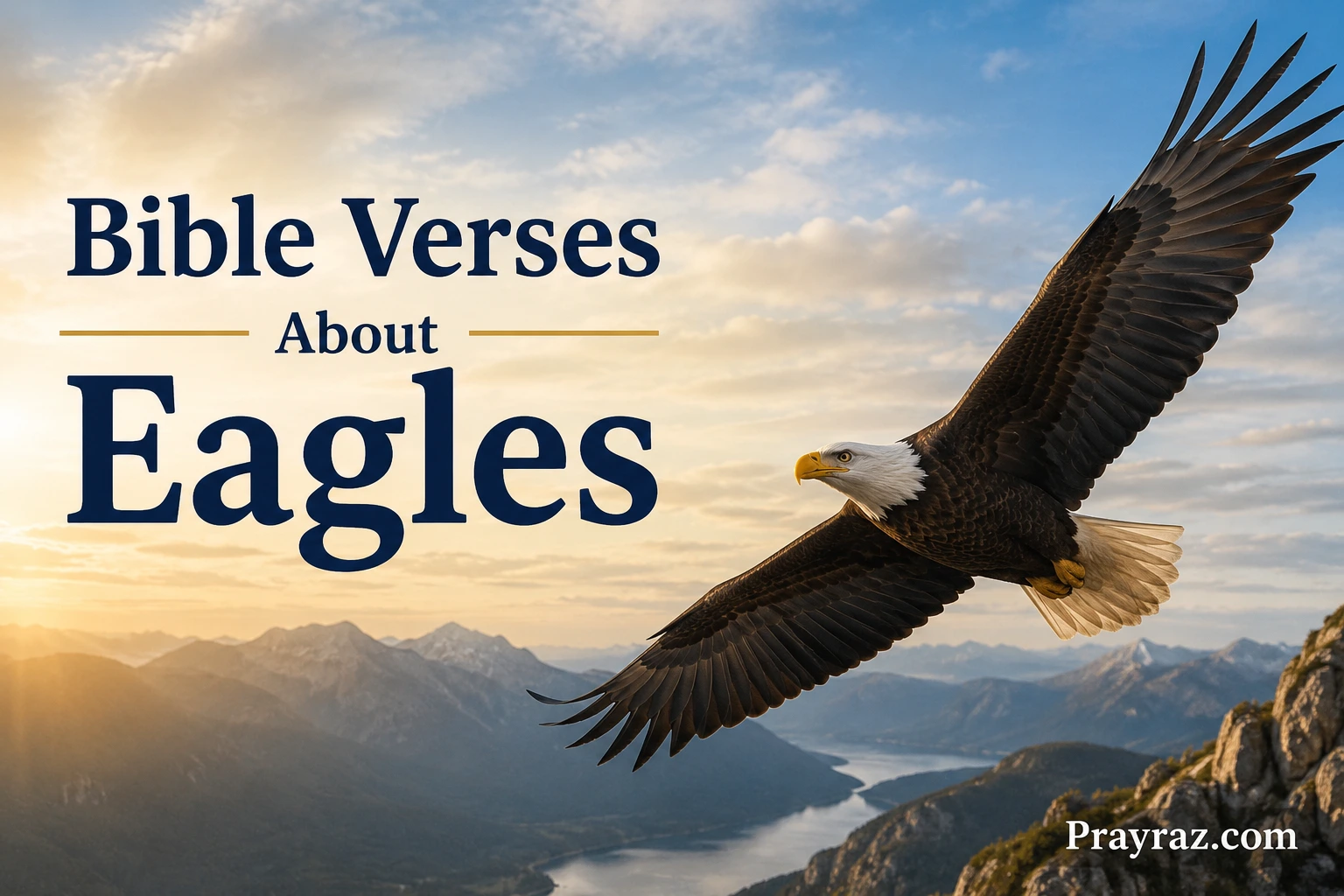
Eagles are among the most powerful and memorable birds mentioned in Scripture. They are known for strong wings, sharp sight, swift flight, high nests, and the ability to rise above storms. Because of these qualities, the Bible uses eagle imagery to teach deep spiritual truths about God’s strength, protection, judgment, renewal, and care for His people.
When Scripture speaks about eagles, it does not always use the image in the same way. Sometimes the eagle represents hope and renewed strength. At other times, it points to speed, power, pride, danger, or divine judgment. This makes eagle passages rich and meaningful for Bible study, prayer, and personal reflection.
For believers, eagle scriptures can be especially encouraging during seasons of weakness, waiting, fear, spiritual dryness, or pressure. They remind us that human strength has limits, but God’s power does not. They teach us that waiting on the Lord is not wasted time. Instead, it becomes the place where faith is renewed, courage is restored, and the soul learns to rise again.
This guide explores key eagle passages in the Bible, explains their meaning in context, and offers practical spiritual lessons for prayer, devotion, and daily Christian living.
Quick Answer: What Do Eagles Represent in the Bible?
A Short Biblical Summary
In Scripture, eagles often represent strength, speed, renewal, protection, watchfulness, and height. The most well-known passage is Isaiah 40:31, where those who wait upon the Lord are promised renewed strength and are described as mounting up with wings like eagles.
However, eagle symbolism is not only positive. In some prophetic passages, eagles also represent judgment, danger, invading nations, pride, or the sudden arrival of trouble. Because of this, every eagle passage should be understood by reading its surrounding context.
Key Meanings of Eagles in Scripture
Eagles in the Bible can point to:
- Renewed strength from God
- God’s protective care
- Divine rescue and deliverance
- Spiritual endurance
- Swift movement or sudden action
- High places and vision
- Pride and false security
- Judgment against nations
- God’s power over creation
- Hope for the weary believer
The same image can carry different meanings depending on the book, audience, and message. That is why a careful Bible study approach helps us avoid shallow interpretations.
Isaiah 40:31: Mounting Up With Wings Like Eagles
The Verse
Isaiah 40:31 says, “But they that wait upon the LORD shall renew their strength; they shall mount up with wings as eagles…” This is one of the most loved verses in the Bible because it speaks directly to tired hearts.
The verse does not promise that believers will never feel weak. Instead, it gives hope to those who already know what weakness feels like. It speaks to people who are weary, burdened, delayed, discouraged, or spiritually exhausted.
The Meaning of Waiting on the Lord
Waiting on the Lord is not passive hopelessness. It is active trust. It means looking to God with patience, faith, prayer, and obedience while believing that His timing is wise.
In Isaiah 40, God’s people needed reassurance. They were reminded that the Lord is not weak, confused, absent, or limited. Human beings grow tired, but God never does. The promise of renewed strength comes from God’s endless power, not from human effort.
Why Eagles Are Used in This Verse
The eagle is a fitting image because it rises high above the earth. It does not remain trapped at ground level. In the same way, God gives His people strength to rise above fear, despair, and spiritual heaviness.
This does not mean problems disappear instantly. Rather, it means God gives grace to endure them with a renewed heart. A believer may still walk through difficulty, but the soul is lifted by divine strength.
Spiritual Lesson
Isaiah 40:31 teaches that spiritual strength is renewed through dependence on God. When believers stop relying only on their own energy and begin trusting the Lord deeply, they receive strength that is beyond natural ability.
This verse is especially helpful for:
- People facing long delays
- Believers feeling emotionally tired
- Christians waiting for answered prayer
- Anyone carrying heavy responsibility
- Those who need fresh courage
- People recovering from disappointment
Prayer Based on Isaiah 40:31
Lord, renew my strength as I wait on You. Help me not to lose heart when answers seem delayed. Teach me to trust Your timing, rest in Your power, and rise above fear with faith. Give me the courage to keep walking, running, and soaring by Your grace. Amen.
Exodus 19:4: God Carried Israel on Eagles’ Wings
The Verse
In Exodus 19:4, God says to Israel, “Ye have seen what I did unto the Egyptians, and how I bare you on eagles’ wings, and brought you unto myself.”
This verse comes after God delivered Israel from slavery in Egypt. Before giving the covenant at Mount Sinai, God reminded His people that their rescue was not random. He had carried them, protected them, and brought them near to Himself.
What Eagles’ Wings Mean Here
The phrase “eagles’ wings” points to God’s powerful and tender deliverance. Israel could not free itself from Egypt. The Lord acted with mighty power and brought His people out.
This image shows both strength and care. God is not only strong enough to rescue; He is loving enough to carry. The verse reveals a God who does not abandon His people in bondage but brings them into relationship with Himself.
God Brings His People to Himself
The most beautiful part of Exodus 19:4 is not only that God brought Israel out of Egypt. It is that He brought them to Himself. Deliverance was not merely about escape. It was about covenant relationship.
This teaches believers that God’s rescue has a purpose. He does not simply remove us from danger; He draws us closer to His presence.
Spiritual Lesson
Exodus 19:4 reminds us that God carries His people when they cannot carry themselves. During seasons of fear, transition, or weakness, this verse encourages believers to remember past deliverance.
When God brings someone through a difficult season, it is not only proof of survival. It is evidence of His faithful care.
Prayer Based on Exodus 19:4
Father, thank You for carrying me through places I could not survive on my own. Remind me of Your past faithfulness when I feel afraid. Bring me closer to Yourself and help me trust Your care in every season. Amen.
Deuteronomy 32:11: The Eagle Stirring the Nest
The Verse
Deuteronomy 32:11 compares God’s care to an eagle stirring its nest, fluttering over its young, spreading its wings, and carrying them.
This passage appears in the Song of Moses. It reflects on God’s relationship with Israel and His faithful guidance through the wilderness.
The Meaning of the Stirred Nest
The picture of the eagle stirring the nest is powerful. A nest is a place of comfort and safety. Yet growth often requires movement beyond comfort. The image suggests training, guidance, protection, and preparation.
God sometimes allows His people to be moved from places of ease so they can learn deeper trust. He does not do this to harm them. He does it to mature them.
God’s Care Is Both Gentle and Strong
The eagle image in Deuteronomy 32:11 is not careless or harsh. The eagle watches, hovers, spreads wings, and carries. This shows careful involvement.
Likewise, God may lead His people through wilderness seasons, but He does not leave them unattended. His discipline is joined with compassion. His training is joined with protection.
Spiritual Lesson
This verse teaches that spiritual growth may involve discomfort. God may disturb our false security, not because He is against us, but because He is forming stronger faith within us.
A believer may experience this through:
- A life transition
- A change of plans
- A season of waiting
- A challenge that builds endurance
- A call to deeper obedience
- A step of faith beyond comfort
Prayer Based on Deuteronomy 32:11
Lord, help me trust You when You stir the nest of my comfort. Teach me to grow, obey, and depend on You more deeply. Cover me with Your wings, guide me with wisdom, and carry me when I feel weak. Amen.
Psalm 103:5: Renewed Youth Like the Eagle’s
The Verse
Psalm 103:5 says that God satisfies His people with good things so that their youth is renewed like the eagle’s.
This verse appears in a psalm of praise. David blesses the Lord for forgiveness, healing, redemption, mercy, compassion, and renewal.
What Renewal Means in This Psalm
The renewal in Psalm 103 is not merely physical energy. It is a deeper restoration of the whole person. The psalm celebrates God’s ability to revive the soul, restore hope, and refresh His people with mercy.
The eagle image suggests vitality, strength, and fresh life. It reminds believers that God can renew what feels tired, worn down, or spiritually dry.
God Satisfies the Soul
Psalm 103:5 connects renewal with satisfaction. The Lord satisfies His people with good things. This does not mean every earthly desire is instantly fulfilled. It means God Himself becomes the source of deep restoration.
A soul satisfied in God can regain strength even when life remains challenging.
Spiritual Lesson
This verse encourages believers to praise God for daily renewal. His mercy is not only for the moment of salvation. It continues throughout the believer’s journey.
God renews through:
- His Word
- Prayer
- Worship
- Forgiveness
- Spiritual rest
- Godly community
- Remembering His benefits
- Trusting His compassion
Prayer Based on Psalm 103:5
Lord, satisfy my soul with Your goodness. Renew my strength, refresh my spirit, and restore my hope. Help me remember Your mercy and praise You for every blessing. Amen.
Job 39:27-30: The Eagle and God’s Wisdom in Creation
The Passage
In Job 39, God asks Job whether the eagle mounts up at his command and makes its nest on high. The passage describes the eagle dwelling on cliffs, seeking prey, and seeing from far away.
This section is part of God’s response to Job. After Job’s suffering and questions, God points to creation to reveal His wisdom, power, and authority.
The Eagle Shows God’s Creative Power
The eagle in Job 39 is not mainly a symbol of personal encouragement. It is evidence of God’s rule over creation. The Lord designed the eagle with instincts, strength, vision, and ability that humans cannot fully command.
God’s questions remind Job that creation is filled with divine wisdom beyond human control.
Spiritual Lesson
Job 39 teaches humility. Human beings do not understand everything God governs. The eagle’s life, flight, nesting, and vision are under the Creator’s authority.
When believers face suffering they cannot explain, this passage reminds them that God’s wisdom is larger than human understanding.
Devotional Reflection
Sometimes faith means admitting, “Lord, I do not see everything You see.” The eagle sees from far away, but God sees infinitely more. He sees the beginning, middle, and end of every story.
This truth can comfort those who feel confused by painful circumstances. God’s wisdom remains steady even when life feels unclear.
Proverbs 23:5: Riches Flying Away Like an Eagle
The Verse
Proverbs 23:5 warns that riches can make themselves wings and fly away like an eagle toward heaven.
This is one of the Bible’s clearest reminders that earthly wealth is uncertain. The eagle image emphasizes speed and sudden disappearance.
The Meaning of the Warning
Money can seem secure, but it is not a reliable foundation for the soul. Wealth can be lost through disaster, poor choices, economic trouble, injustice, illness, or death. Proverbs uses eagle imagery to show how quickly earthly security can vanish.
The verse does not say money itself is evil. Rather, it warns against setting the heart on riches.
Spiritual Lesson
This passage teaches believers to place their trust in God rather than possessions. Earthly resources are temporary, but God’s faithfulness is eternal.
A wise believer uses money responsibly but does not worship it. Wealth should serve God’s purposes, not rule the heart.
Prayer for a Right View of Wealth
Lord, keep my heart free from greed and false security. Help me use resources wisely, give generously, and trust You more than earthly possessions. Amen.
Proverbs 30:17: The Eagle as an Image of Judgment
The Verse
Proverbs 30:17 speaks of the eye that mocks a father and despises obedience to a mother. It gives a vivid warning involving ravens and young eagles.
This is a strong wisdom saying about dishonor, rebellion, and the seriousness of disrespect.
Understanding the Image Carefully
This verse uses intense imagery to show the danger of prideful contempt toward parents. It is not written as a gentle encouragement. It is a warning.
The mention of eagles here is connected to judgment and consequence, not renewal or comfort. This reminds readers that eagle imagery in Scripture must always be interpreted in context.
Spiritual Lesson
Proverbs 30:17 teaches that God takes honor, humility, and family responsibility seriously. A mocking spirit is not a small issue in biblical wisdom. It reveals a heart that resists correction.
For prayer and reflection, this verse can lead believers to ask God for humility, respect, and a teachable spirit.
Proverbs 30:18-19: The Way of an Eagle in the Air
The Passage
Proverbs 30:18-19 mentions “the way of an eagle in the air” as one of several things too wonderful for the writer.
This passage reflects wonder at mysteries in creation and life. The eagle’s flight is presented as something beautiful, skillful, and difficult to trace.
The Beauty of Mystery
An eagle moves through the sky with power and grace. Its path cannot be easily marked. The writer sees this as one of the wonders of the created world.
This reminds believers that not everything beautiful can be fully explained. Some parts of God’s world are meant to awaken awe.
Spiritual Lesson
The eagle’s path in the air can inspire worship. Creation invites believers to marvel at the wisdom of God. Wonder is a healthy part of faith because it reminds us that life is larger than what we can measure.
A prayerful heart does not need to control every mystery. It can stand in awe before the Creator.
Obadiah 1:4: Pride That Builds Too High
The Verse
Obadiah 1:4 says that even if Edom exalted itself like the eagle and set its nest among the stars, God would bring it down.
This is a prophetic warning against pride, arrogance, and false security.
The Eagle Image in Obadiah
Here, the eagle is linked with height. Edom saw itself as secure, protected by its location and power. The image of an eagle nesting high among the stars shows extreme self-confidence.
But the Lord declares that no height is beyond His reach. Pride cannot hide from God.
Spiritual Lesson
Obadiah 1:4 warns believers not to confuse high position with true security. A person may feel untouchable because of wealth, status, talent, success, or influence. Yet pride always places the soul in danger.
God calls His people to humility. True safety is not found in self-exaltation but in surrender to Him.
Prayer Against Pride
Lord, protect my heart from pride. Keep me from trusting in position, success, or human strength. Teach me humility and help me find my security in You alone. Amen.
Jeremiah 49:16: The Deception of Lofty Places
The Verse
Jeremiah 49:16 contains a warning similar to Obadiah. It speaks of a people deceived by pride, dwelling in high places, and making a nest as high as the eagle.
Pride Can Deceive the Heart
The verse says pride deceived the people. This is important because pride often feels like confidence, wisdom, or strength. Yet it can blind the heart to danger.
The eagle’s high nest becomes a picture of false safety. The people thought their position made them secure, but God saw the truth.
Spiritual Lesson
This passage reminds believers to examine the places where they feel untouchable. Pride can hide in success, knowledge, religious activity, independence, or control.
A humble person remains teachable before God. They understand that every gift, opportunity, and protection comes from Him.
Lamentations 4:19: Enemies Swifter Than Eagles
The Verse
Lamentations 4:19 says that pursuers were swifter than the eagles of heaven.
This verse appears in a book filled with grief over Jerusalem’s suffering and destruction. The eagle image communicates speed, danger, and the overwhelming nature of pursuit.
Not Every Eagle Reference Is Comforting
Many readers quickly associate eagles with hope because of Isaiah 40:31. Yet Lamentations uses the image differently. Here, eagles describe the speed of enemies and the pain of judgment.
This teaches us to read Scripture carefully. A biblical symbol can carry more than one meaning.
Spiritual Lesson
Lamentations 4:19 reminds believers that sin, injustice, and rebellion bring serious consequences. It also shows that the Bible does not ignore pain. Scripture gives language for grief, fear, and devastation.
Even in dark passages, God’s Word invites honest prayer. Believers can bring sorrow before the Lord instead of pretending everything is easy.
Ezekiel 17: The Parable of the Two Eagles
The Chapter
Ezekiel 17 contains a symbolic parable involving two great eagles, a cedar, seed, and a vine. The passage speaks about political betrayal, covenant unfaithfulness, and judgment.
This is one of the more complex eagle passages in Scripture. It is not mainly about personal motivation. It is a prophetic message to a nation.
What the Eagles Represent
In Ezekiel 17, the eagles represent powerful kingdoms or rulers involved in the affairs of Judah. The imagery helps communicate political dependence, broken promises, and divine judgment.
The chapter shows that God cares about faithfulness, even in national and political matters. Broken covenants are not hidden from Him.
Spiritual Lesson
Ezekiel 17 teaches that God values faithfulness. Whether in personal life, leadership, relationships, or public responsibility, promises matter.
The eagle imagery reminds us that earthly powers may seem impressive, but God remains the final Judge over nations and rulers.
Daniel 7:4: Eagle’s Wings and Worldly Power
The Verse
Daniel 7:4 describes the first beast as being like a lion with eagle’s wings. This prophetic vision is symbolic and points to earthly kingdoms and power.
Eagle Wings in Apocalyptic Imagery
In Daniel, eagle wings suggest speed, reach, and imperial strength. The image is not about personal renewal but about the movement and power of kingdoms.
This kind of passage requires careful interpretation. Apocalyptic literature uses vivid symbols to reveal spiritual truths about history, empire, judgment, and God’s kingdom.
Spiritual Lesson
Daniel 7 reminds believers that earthly empires rise and fall, but God’s kingdom remains. Political powers may look strong, swift, and unstoppable, but they are still accountable to the Lord.
For modern readers, this brings comfort. The world can feel unstable, yet God is not threatened by human power.
Hosea 8:1: The Eagle as a Sign of Coming Judgment
The Verse
Hosea 8:1 speaks of an eagle coming against the house of the Lord because the people transgressed God’s covenant.
This is another example where the eagle image warns of judgment rather than comfort.
Covenant Unfaithfulness
Hosea often deals with spiritual unfaithfulness. God’s people had turned from Him while still maintaining outward religious identity. The eagle image shows that judgment would come swiftly.
The warning is serious. Religious appearance cannot replace covenant faithfulness.
Spiritual Lesson
Hosea 8:1 calls believers to sincere devotion. God desires hearts that are faithful, not merely religious habits without obedience.
This passage encourages self-examination. Are we honoring God only with words, or are we walking with Him in truth?
Habakkuk 1:8: Eagles and the Speed of Conquest
The Verse
Habakkuk 1:8 describes horses swifter than leopards and horsemen flying like an eagle that hastens to eat.
This verse describes the speed and ferocity of an invading force. Again, the eagle image emphasizes swift movement and danger.
A Difficult Message
Habakkuk struggled with questions about injustice, evil, and God’s ways. The book does not offer shallow answers. Instead, it shows a prophet bringing honest questions before the Lord.
The eagle image in this verse belongs to that difficult context. It is part of a message about judgment and the rise of a powerful enemy.
Spiritual Lesson
Habakkuk teaches believers that faith can wrestle honestly with God. When life does not make sense, prayer is still the right place to go.
The book later declares that the just shall live by faith. That truth becomes even stronger when read against the background of fear and uncertainty.
Revelation 12:14: Wings of a Great Eagle
The Verse
Revelation 12:14 says the woman was given two wings of a great eagle, so she could fly into the wilderness to her place, where she was nourished.
This is symbolic apocalyptic language. Revelation uses vivid images to communicate spiritual realities involving conflict, protection, persecution, and God’s preserving care.
Protection in the Wilderness
The eagle wings in Revelation 12 connect with themes of escape, divine provision, and protection. The wilderness may seem like a place of danger, but in Scripture it can also become a place where God sustains His people.
This echoes earlier biblical themes, including God carrying Israel on eagles’ wings and caring for His people in the wilderness.
Spiritual Lesson
Revelation 12:14 reminds believers that God can protect and nourish His people even in hostile places. The wilderness is not beyond His reach.
For Christians facing pressure, this passage offers hope that God’s care is present even when circumstances feel severe.
Matthew 24:28 and Luke 17:37: Eagles, Vultures, and Judgment
The Passages
Matthew 24:28 and Luke 17:37 include a saying about eagles or vultures gathering where the carcass is. Different translations handle the bird term differently because the original word can be understood in connection with large birds of prey.
Why Context Matters
These passages appear in teachings about judgment and the coming of the Son of Man. The image is not about spiritual renewal. It points to certainty, visibility, and judgment.
This is a helpful reminder that not every mention of eagles should be turned into a motivational message. Some passages are warnings.
Spiritual Lesson
Jesus’ words call readers to spiritual readiness. The focus is not curiosity about symbols but preparation of the heart before God.
A prayerful response to these passages is simple: Lord, keep me awake, faithful, and ready.
Eagles as Unclean Birds in the Law
Old Testament References
The eagle appears in lists of birds that Israel was not permitted to eat, including Leviticus 11:13 and Deuteronomy 14:12.
These passages belong to Israel’s dietary laws under the Old Covenant. They helped distinguish Israel as a holy people and shaped daily obedience.
Why This Matters
Some readers may be surprised to see eagles listed in this way. However, this does not make every eagle reference negative. The Bible can use the same animal in different ways depending on context.
An eagle can be an unclean bird in dietary law, a symbol of renewal in Isaiah, a picture of God’s care in Exodus, or an image of judgment in prophecy.
Spiritual Lesson
These passages teach careful reading. Biblical symbols are not flat. They are shaped by context, genre, and purpose.
For believers, this encourages deeper study rather than quick assumptions.
Major Spiritual Lessons From Eagle Scriptures
God Renews the Weak
One of the strongest lessons from eagle imagery is that God renews those who feel weak. Isaiah 40:31 does not speak to people who are already strong in themselves. It speaks to those who need strength from the Lord.
This is good news because every believer eventually reaches the end of personal energy. There are seasons when motivation fades, prayers feel heavy, and the heart becomes tired. In those moments, God does not shame His people for weakness. He invites them to wait on Him.
God Carries His People
Exodus 19:4 shows God carrying Israel on eagles’ wings. This picture is deeply comforting because it reminds us that deliverance begins with God’s action.
Many believers can look back and say, “The Lord carried me.” They may not have understood it at the time, but later they see His hand in protection, provision, healing, guidance, or rescue.
God Trains Us Through Discomfort
Deuteronomy 32:11 teaches that God may stir the nest. Comfort is good, but it can become a place of spiritual laziness if we refuse growth. The Lord sometimes moves His people into new places where faith must become active.
This does not mean every hardship is easy to explain. It means God is able to work in discomfort and use it for spiritual maturity.
God Warns Against Pride
Obadiah and Jeremiah use eagle imagery to warn against pride. The high nest becomes a symbol of arrogance and false safety.
This is a needed lesson. People often trust in their own height, such as status, money, education, influence, beauty, skill, or control. Yet God sees beyond appearances. He calls His people to humility.
God Rules Over Nations
Ezekiel, Daniel, Hosea, and Habakkuk use eagle imagery in contexts involving nations, empires, conquest, and judgment. These passages remind us that God is Lord over history.
World events may look chaotic, but Scripture teaches that God remains sovereign. No earthly power is beyond His authority.
God Protects in the Wilderness
Revelation 12:14 shows eagle wings as part of a symbolic picture of protection and nourishment. God’s people may pass through wilderness seasons, but the wilderness is not a place where God disappears.
He can provide strength, shelter, wisdom, and spiritual food in places that feel lonely or unsafe.
How to Apply Eagle Scriptures to Daily Life
When You Feel Spiritually Tired
When your soul feels tired, meditate on Isaiah 40:31. Do not rush past the word “wait.” Ask God to teach you patient trust.
You can pray:
“Lord, I feel weak, but You are strong. Renew my strength as I wait on You.”
When You Need Comfort From God’s Care
When you feel unsupported, remember Exodus 19:4. God carried Israel before they fully understood His plan. He was faithful before they arrived at Sinai.
You can pray:
“Father, carry me through this season and bring me closer to Yourself.”
When God Is Moving You Out of Comfort
When life changes suddenly, reflect on Deuteronomy 32:11. The stirred nest may feel unsettling, but God can use it to teach deeper faith.
You can pray:
“Lord, help me trust Your training, even when growth feels uncomfortable.”
When You Are Tempted by Pride
When success makes you feel self-sufficient, read Obadiah 1:4 and Jeremiah 49:16. These verses remind the heart that no height is greater than God.
You can pray:
“Lord, keep me humble and dependent on You.”
When You Feel Afraid of World Events
When nations, leaders, or global problems feel overwhelming, read Daniel 7 and remember that God’s kingdom is greater than every earthly empire.
You can pray:
“King of heaven, help me trust Your rule above all human power.”
A Devotional Reflection on Soaring Like an Eagle
Rising Above Ground-Level Fear
Eagles are known for flying high. This image can help believers think about spiritual perspective. Fear keeps the heart close to the ground. Faith lifts the eyes toward God.
To soar spiritually does not mean ignoring reality. It means seeing reality in light of God’s promises. Problems are real, but they are not greater than the Lord.
Strength Comes From Surrender
Many people think strength means trying harder. Scripture often teaches something deeper. True spiritual strength comes from surrender to God.
Isaiah 40:31 connects renewal with waiting. This means the believer receives strength not by frantic striving, but by trusting the Lord.
The Storm Does Not Have the Final Word
Eagles are often associated with rising above storms. While this exact idea is more devotional than directly stated in one verse, it fits the broader biblical theme of God helping His people endure trouble.
The Christian life is not free from storms. Yet God gives grace to rise in faith, continue in obedience, and remain anchored in hope.
Prayers Inspired by Eagle Scriptures
Prayer for Renewed Strength
Lord, I come to You tired and in need of renewal. My strength is limited, but Yours is endless. Teach me to wait on You with faith. Lift my heart above fear, restore my courage, and help me keep walking in obedience. Amen.
Prayer for Divine Protection
Father, thank You for carrying Your people on eagles’ wings. Cover me with Your care today. Protect my mind from fear, my heart from discouragement, and my steps from danger. Bring me closer to You through every situation. Amen.
Prayer for Spiritual Growth
Lord, when You stir the nest of my comfort, help me not resist Your work. Give me courage to grow, wisdom to obey, and faith to follow where You lead. Carry me when I am weak and teach me to trust Your wings beneath me. Amen.
Prayer Against Pride
God, search my heart and remove pride from me. Keep me from building my security in success, status, or control. Teach me humility. Help me remember that every good thing comes from You. Amen.
Prayer for Hope in the Wilderness
Lord, nourish me in wilderness seasons. When I feel alone, remind me that You are near. Give me strength, direction, and peace. Help me see Your provision even in difficult places. Amen.
Bible Study Tips for Eagle Passages
Read the Whole Chapter
A single verse can be powerful, but context gives it proper meaning. Before applying an eagle passage personally, read the surrounding chapter. Ask what situation the passage addresses.
For example, Isaiah 40 is about comfort and God’s greatness. Obadiah is about pride and judgment. Ezekiel 17 is a prophetic parable. Each context shapes the meaning.
Notice the Genre
The Bible includes poetry, law, prophecy, wisdom, history, gospel teaching, and apocalyptic vision. Eagle imagery changes depending on the genre.
A poetic verse may use eagles as a picture of renewal. A prophetic passage may use eagles as a symbol of invasion. A wisdom proverb may use eagle imagery to teach a moral lesson.
Avoid Forcing One Meaning Everywhere
It is tempting to make every eagle reference mean strength or success. However, Scripture is richer than that. Eagles can symbolize several ideas.
Faithful interpretation respects the Bible’s own message.
Turn Study Into Prayer
After reading eagle passages, turn the truth into prayer. Ask God what the passage reveals about His character, your heart, and your response.
Good Bible study should lead not only to knowledge but also to worship, humility, and obedience.
Encouraging Eagle Scriptures for Difficult Seasons
For Weariness
Isaiah 40:31 is ideal for seasons of exhaustion. It reminds believers that the Lord renews those who wait on Him.
When you feel drained, do not assume God is finished with you. Weakness can become the place where His strength is revealed.
For Remembering God’s Rescue
Exodus 19:4 helps believers look back with gratitude. God has carried His people before, and He remains faithful.
Remembering past deliverance can strengthen present faith.
For Restoration
Psalm 103:5 encourages praise because God renews His people. Spiritual renewal is part of His mercy.
When your heart feels dull, ask God to restore fresh joy in Him.
For Growth
Deuteronomy 32:11 is helpful when life feels uncomfortable. God may be training, guiding, and strengthening you in ways you do not yet understand.
Growth often begins when comfort is disturbed.
For Humility
Obadiah 1:4 and Jeremiah 49:16 are useful warnings. They remind believers that pride can make people feel safe while leading them away from God.
Humility keeps the soul close to grace.
Common Misunderstandings About Eagles in the Bible
Misunderstanding 1: Eagles Always Mean Blessing
Eagles often represent strength and renewal, but not always. Some passages use eagle imagery for judgment, danger, or pride.
A balanced study includes both encouragement and warning.
Misunderstanding 2: Isaiah 40:31 Means Life Will Be Easy
Isaiah 40:31 does not promise a trouble-free life. It promises renewed strength. The verse includes mounting up, running, and walking. This suggests different levels of endurance for different seasons.
God gives soaring strength. Sometimes He gives running strength. Sometimes He gives walking strength. All are gifts of grace.
Misunderstanding 3: Eagle Symbolism Should Be Separated From Context
Biblical imagery should never be separated from the message of the passage. A symbol becomes meaningful because of how Scripture uses it.
Context protects readers from turning Bible verses into vague inspirational sayings.
Misunderstanding 4: Waiting on God Means Doing Nothing
Waiting on the Lord is active trust. It includes prayer, obedience, patience, worship, and faithfulness.
A person can wait on God while still taking wise steps.
Short Eagle Bible Verses for Memorization
Isaiah 40:31
This is the most well-known eagle verse and a powerful memory verse for strength, waiting, and endurance.
Exodus 19:4
This verse is helpful for remembering God’s rescue and covenant care.
Psalm 103:5
This verse encourages praise for God’s renewing mercy.
Deuteronomy 32:11
This verse reminds believers of God’s protective training and guidance.
Obadiah 1:4
This verse is a strong warning against pride and false security.
How Eagle Scriptures Build Faith
They Lift the Eyes to God
Eagle passages often move our attention upward. They remind us that God sees more than we see and rules over what we cannot control.
Faith grows when the heart stops staring only at problems and starts looking to the Lord.
They Strengthen the Weary
Many believers feel tired but do not know how to express it. Isaiah 40 gives language for that weakness and hope for renewal.
God is not offended by human limits. He invites the weary to receive strength from Him.
They Encourage Trust During Change
The stirred nest in Deuteronomy teaches that change can become part of God’s training. While change may feel uncomfortable, it can produce stronger dependence on the Lord.
They Warn the Proud
Eagle imagery also warns people who build their nests too high. Pride may feel powerful, but it is spiritually dangerous.
The safest place is not the highest place of self-exaltation. It is the humble place under God’s authority.
They Reveal God’s Sovereignty
Prophetic eagle passages show that God rules over nations, history, and judgment. This helps believers remain steady in uncertain times.
The Lord is never surprised by earthly powers.
Frequently Asked Questions
What does an eagle symbolize in the Bible?
An eagle can symbolize strength, speed, renewal, protection, height, vision, judgment, or pride, depending on the passage. Isaiah 40:31 uses eagle imagery for renewed strength, while Obadiah 1:4 uses it as a warning against pride.
What Bible verse says believers will mount up with wings like eagles?
Isaiah 40:31 says that those who wait upon the Lord shall renew their strength and mount up with wings like eagles. It is a promise of divine strength for those who trust God.
Why does Isaiah 40:31 compare God’s people to eagles?
Isaiah 40:31 uses the eagle image to show rising strength, endurance, and renewed hope. Just as an eagle rises high, God gives His people strength to rise above weariness and continue in faith.
What does God carrying Israel on eagles’ wings mean?
Exodus 19:4 means that God rescued Israel with power and care. He delivered them from Egypt and brought them to Himself. The image shows divine protection, rescue, and covenant love.
Is the eagle always a positive symbol in Scripture?
No. Eagles can represent renewal and protection, but they can also symbolize judgment, danger, pride, or swift invasion. The meaning depends on the context of each passage.
What can Christians learn from eagle scriptures?
Christians can learn to wait on God, trust His strength, remember His care, stay humble, grow through discomfort, and rely on His protection during difficult seasons.
What is the spiritual meaning of eagle wings?
Eagle wings often point to strength, rescue, protection, and the ability to rise above difficulty. In Exodus 19:4, they show God carrying His people. In Isaiah 40:31, they show renewed strength for those who wait on the Lord.
How can I pray using eagle Bible passages?
You can turn each passage into prayer. For example, from Isaiah 40:31, ask God to renew your strength. From Exodus 19:4, thank Him for carrying you. From Obadiah 1:4, ask Him to remove pride from your heart.
Conclusion: Rising in God’s Strength
Eagle scriptures offer both comfort and correction. They remind believers that God renews the weary, carries the weak, protects His people, and gives strength beyond human ability. They also warn against pride, false security, and spiritual rebellion.
The most loved eagle passage, Isaiah 40:31, teaches that those who wait on the Lord receive renewed strength. This promise is not based on perfect circumstances. It is based on God’s unchanging power. When life feels heavy, the believer can still rise through faith, prayer, and trust in the Lord.
At the same time, the wider biblical picture keeps us balanced. Eagles in Scripture are not only symbols of inspiration. They also appear in passages about judgment, speed, pride, and the sovereignty of God over nations. This fuller view helps us read the Bible with wisdom and reverence.
Whether you feel tired, afraid, uncertain, humbled, or ready for spiritual renewal, eagle passages can lead you back to God’s strength. The Lord who carried Israel, renewed the weary, and ruled over history is still faithful today. Wait on Him, trust His care, and let your heart rise again in His power.
